

Starships I-L

|
Advanced
Starship Design Bureau Starships I-L |
||
|
|||
| Starships | Shuttles | Equipment | Technology | History | Other | New | Submit | |||

 Starships
Starships A-B, C-E, F-H,
I-L, M-N, O-Q, R-S, T-Z, Space Stations
Ignacio Class
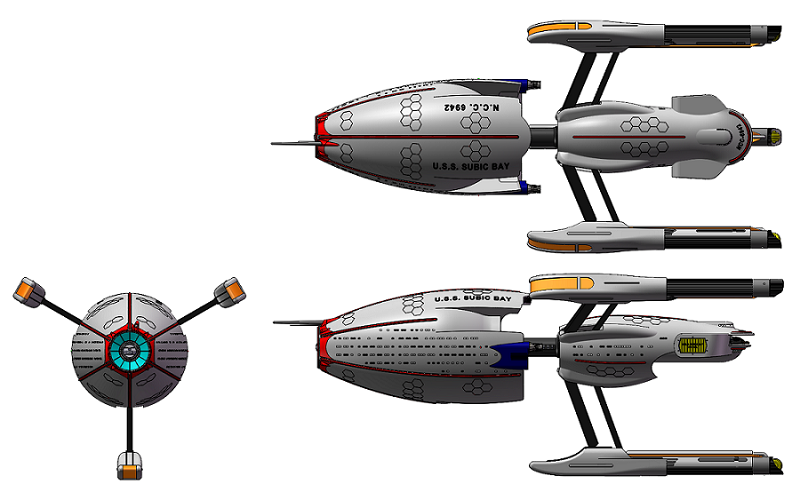
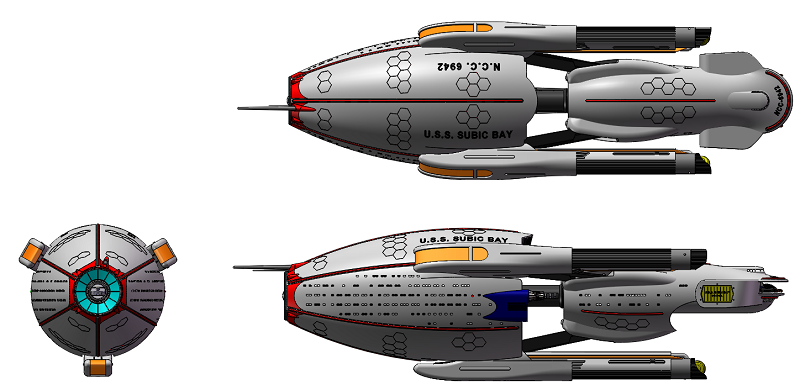
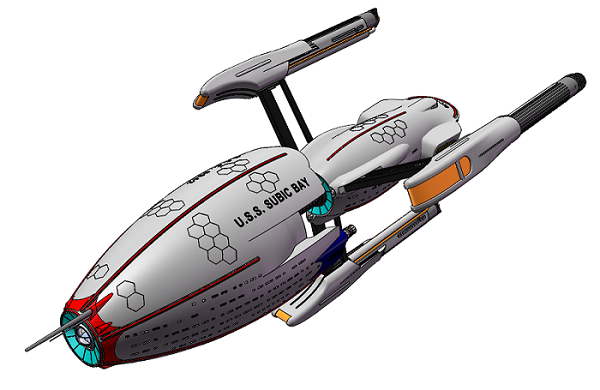 Design by Benjamin I Waddell
Type: Rapid response
First commissioned: 2342
Length: 214m
Width: 103m
Height: 90m
Decks: 10
Complement: 35 officers + 150 crew, evacuation limit: 250
Speed: Warp 7.5 (cruise), Warp 9.64 (max.), Warp 9.98 (max. emergency)
Armament: 9 phaser strips, 2 fwd torpedo launchers, 2 aft torpedo launchers
Defense: experimental metaphasic shields
Embarked craft: 2 type 6 shuttles, 4 2-man fighters
The Ignacio class is designed to respond to any kind of emergency, like a space-going police car, fire engine and ambulance rolled into one. The crew compliment is quite small compared to the available space, in order to accommodate mass evacuations. It's armed to the teeth for combat, and maintains stores of surplus medical and other supplies. In combat, its nacelles can retract, making for a smaller target, and improving maneuverability. Unlike many Starfleet ships, the Ignacio class is capable of actual dog-fighting. Rather than two large nacelles, it has three smaller ones. They extend so far in order to protect the crew from the radiation produced when they operate at maximum power. The Ignacio class has twin warp cores for redundancy. A rescue ship is no good if it needs rescuing, itself. Below the hanger bay, the Ignacio class is equipped with anchor points to carry shipping containers of supplies. The hexagonal features on the forward hull are escape pods. The forward and aft hulls can separate, discarding the connecting tube. The bridge is positioned at the nose of the forward hull, with a dome window in the center of the main deflector array. This provides the bridge crew with actual, physical view of the exterior in case monitors go down or there are other technical difficulties.
Impala Class
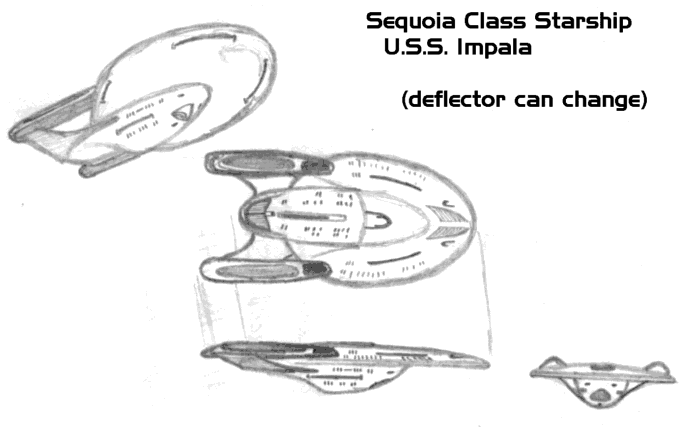 Design by Jason, ASDB Member
No specs available
An ASDB design formerly intended to represent the Sequoia class
Invictus Class
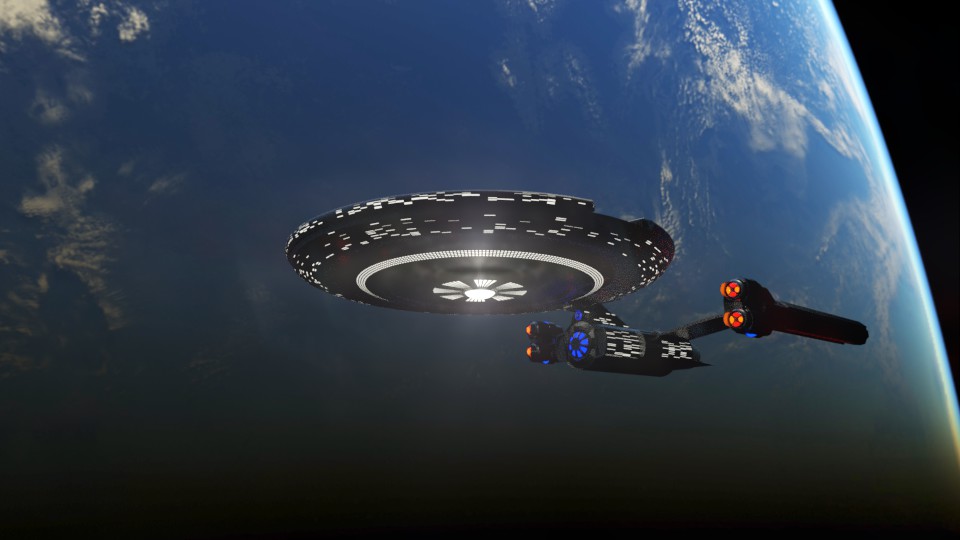
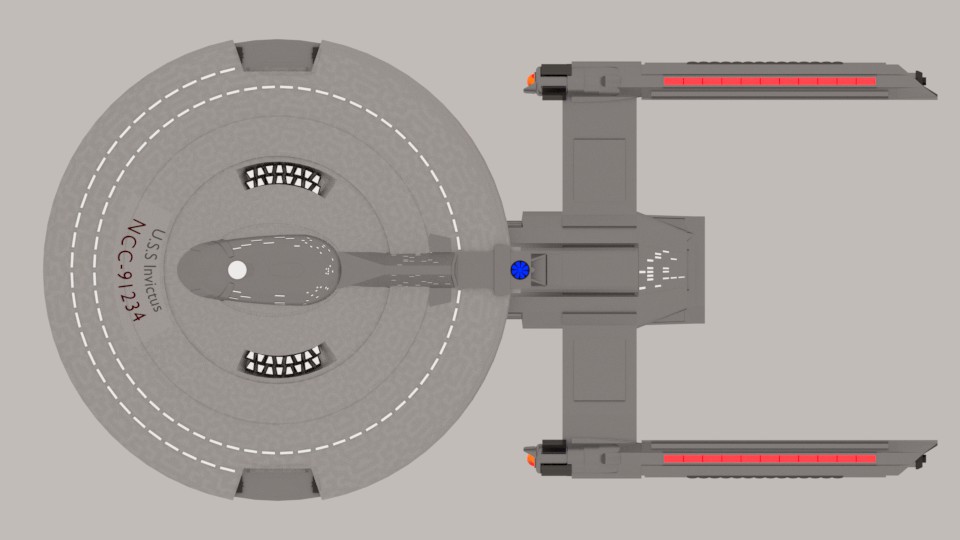
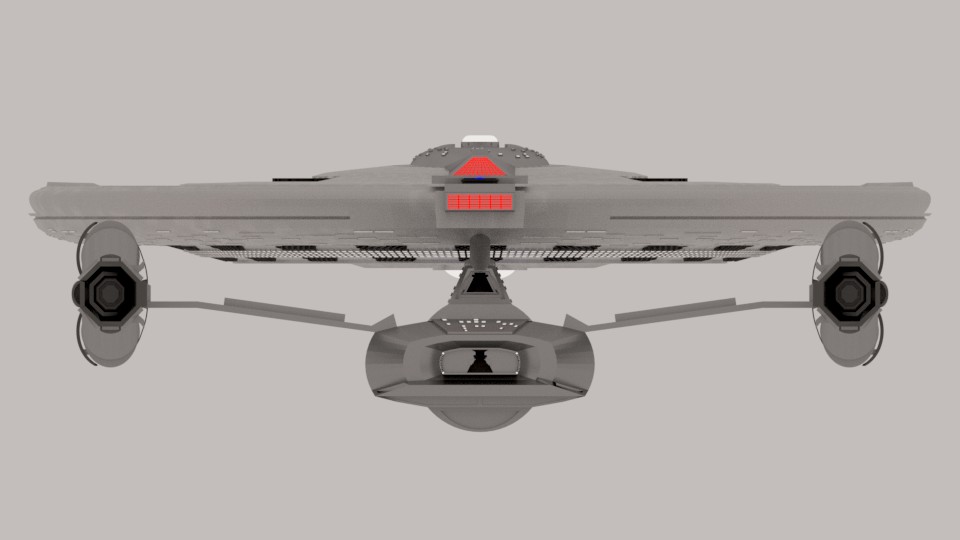
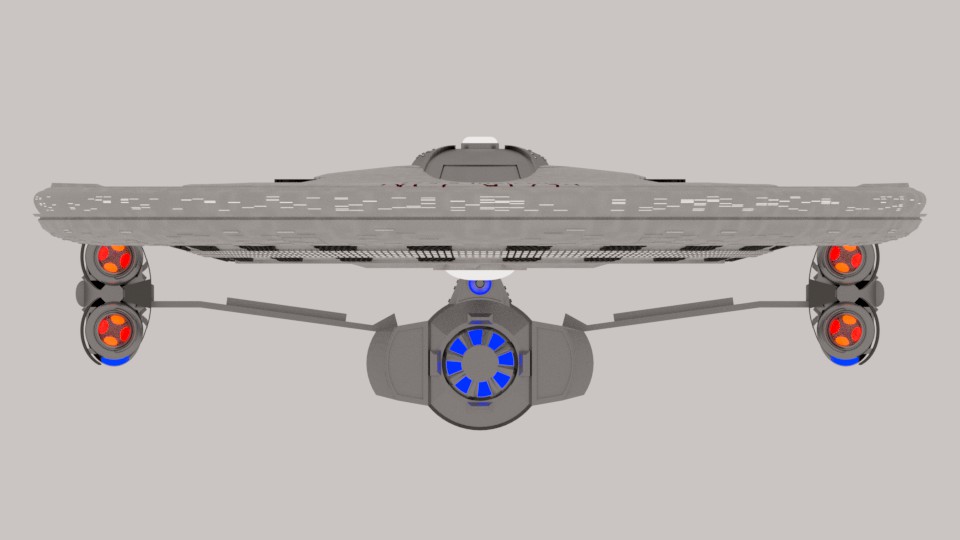
 Design by Gregory Starr
Type: Heavy frigate
First commissioned: 2311
Length: 590m
Width: 304m
Height: 100m
Decks: 34
Displacement: 2,715,326t
Complement: 246 officers + 366 crew, evacuation limit: 529
Speed: Warp 8.92 (cruise), Warp 9.1 (max.), Warp 9.4 (max. emergency)
Sublight speed: 0.8c (max.)
Armament: 3 photon torpedo tubes, 2 heavy phaser banks
Defense: 2 light defense phaser banks
Embarked craft: 3 standard shuttles
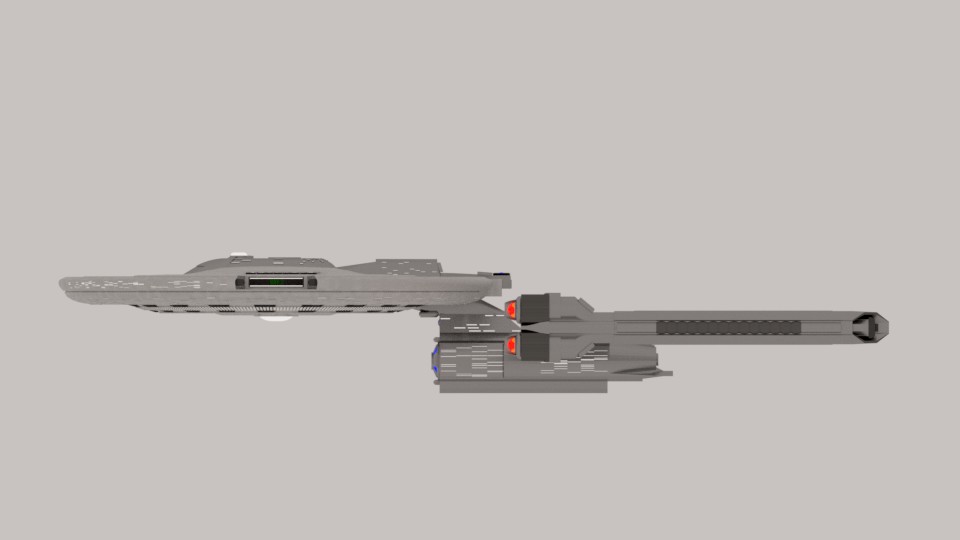
Designed as a heavy frigate, the Invictus class had about average speed for its time, and had armament that lived up to its billing as a heavy frigate. It was rarely used in exploration missions, and most notably served as an escort to a Galactic Plane exploration in 2332. It was used heavily as cannon fodder in the Cardassian War due to its old age and cheap construction, though it was never used in any major conflicts.
Kaiser Class
 Design by Mikey, artwork by Kiribell
Type: Customs vessel
Length: 280m
Beam: 116m
Height: 51m
Decks: 16
Crew: 260 (60 officers, 200 NCO)
Main reactor: 1 Class 8.6 Alpha Reactor
Secondary: 6 Type 15.Xi Fusion Impulse Reactors
Maximum Warp: Warp 9.9 for 36 hours
Energy weapons: 5 Type-X Phaser Strips
Torpedoes: 3 Mk. VI Suss. Fire Torpedo Launchers (2 fwd., 1 turreted), 4
Mk. VI Pulse Fire Torpedo Launchers (2 fwd., 2 aft), 1 Mk. VI Type 4 burst fire torpedo launchers
Defense: MLSS shield system rated at 3,450,000 terajoules
Auxiliary craft: 2 Type-9 shuttles, 1 Type-11 shuttle, 3 Type-18 shuttlepods,
2 workbees, 6 Valkyrie or Raptor fighters/ 8 Osprey fighters/ or 4
Peregrine fighters
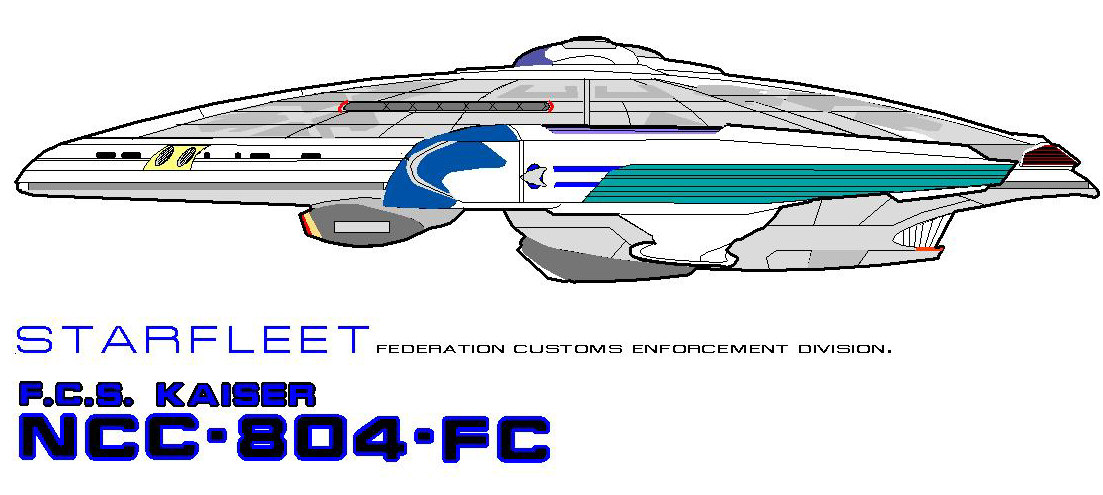
51 ships are in service, 6 under construction, and 23 more planned. 13 are in service with the Customs Enforcers.
King George V Class

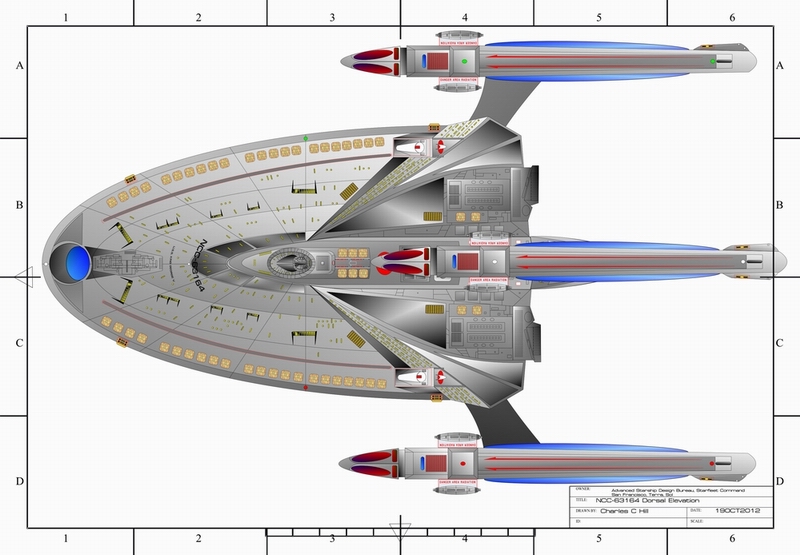
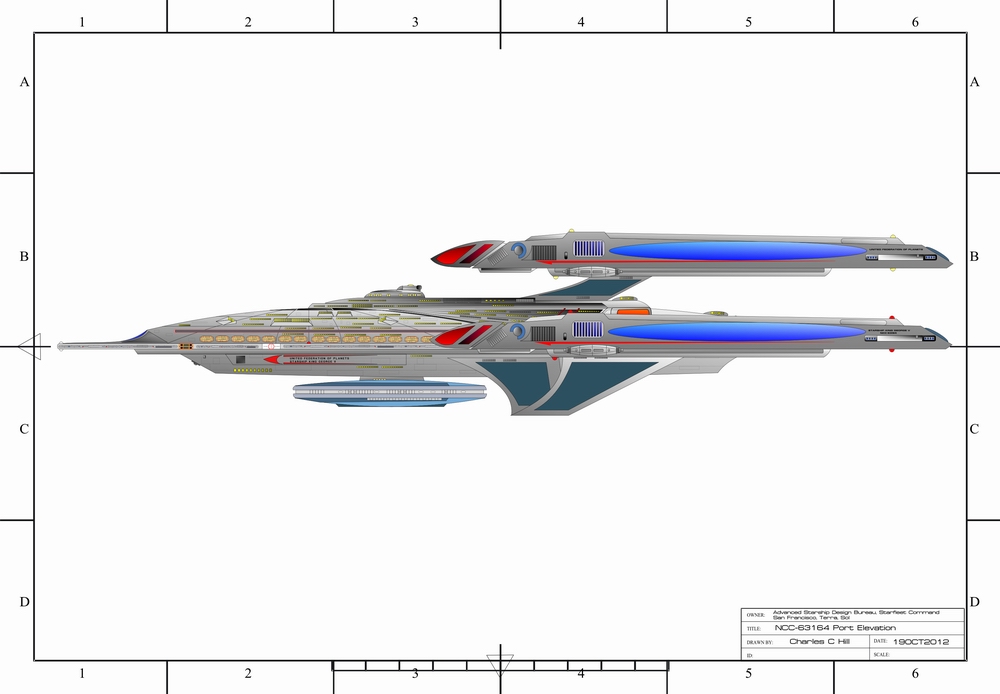 Design by Charles Hill
Type: Tactical cruiser
First commissioned: 2357
Length: 353m
Width: 180m
Height: 86m
Decks: 11
Displacement: 1.8t
Complement: 50 officers + 300 crew
Speed: Warp 7 (cruise), Warp 9.5 (max.), Warp 9.95 (max. emergency)
Sublight speed: 0.7c (max.)
Armament: 7-type X 5.1MW collimated phased energy emitter arrays; 12-type X+
10.2MW collimated phased energy emitter cannons (6 fwd/6 aft); Mk 95 Mod 2 quantum torpedo launch system
(2 fwd/2 aft)
Defense: FSQ-3 primary force field and deflector control system with “RIF” multi-frequency modulation
The idea for a Federation Tactical Cruiser was first put forward by Stefan Leujar at Fleet Operations in 2348. Shifting political associations within the Alpha Quadrant and the UFP sphere of influence were already pushing existing Starfleet resources thin. New dreams of military conquest were stirring within the Cardassian Union; rumors of civil war circulating within the Klingon Empire; Maquis terrorism against Cardassian interests in the Bajoran sector; and the pervasive placidness emanating from the Romulan Star Empire. To add to this list of concerns was the state of the fleet. Aging Excelsior class (NCC-2000) and variants as well as Ambassador class (NCC-10521) were still on the active list performing exploration and first contact duties with the former exceeding spaceframe design limitations. Both classes were due to be replaced by the Nebula class (NCC-61795) and the Galaxy class (NCC-70637), respectively. With the lead ship of both classes off of the drawing board and on the stocks there remained the question about the 80+ year old Miranda class (NCC-1833) still performing front line duties. Thus, there remained a hole in strategic planning because of the age of the Miranda class vessels and its variants (i.e. Ticonderoga, Soyuz, Vol-sulaki and others).
Design history Starfleet Command approached the Advanced Starship Design Bureau (ASDB) with a request for a feasibility study for a potential heavy cruiser design similar to Miranda. After careful consideration of existing technologies and fabrication methods gained from the Nebula and Galaxy projects already in production at Utopia Planitia Yards, ASDB reviewed the Avenger Design and REfit (ADREFT) proposal first mentioned in a publication of Starship Design (USS Menagha: Can This Ship and Her Sisters Fulfil the Battle Cruiser Role?, March 2280). By late 2349 the first blueprints of the Mk XXV Tactical Cruiser project were introduced. Based upon possible scenarios envisioned by Starfleet Operations, the new Mk XXV has a number of criteria which must be met:
1. Survivability in close combat with up to three vessels of comparable size until reinforcements can arrive. This equates to a more powerful and durable deflector grid with the addition of ablative armor over critical areas of the hull. The new deflector technology utilized on both Galaxy and Nebula projects, along with the standard shield generators as primary power will be backed up by a non-propulsive warp nacelle for secondary power. This will enable the Mk XXV with incredible staying power.
2. Exceptional maneuverability at both sub-light and warp speeds provided by improvements in structural integrity field technology and knowledge of warp field geometry.
3. Punching power, in order that item 1 is met the Mk XXV must be able to outgun its opponent. This will be accomplished with improved phaser technology which is currently be utilized on the Nebula and Galaxy lead ships.
4. This class of vessel will be required to operate autonomously for extended periods of time at the extreme edges of Federation space against both known and unknown threat vectors.
Due to its more combat specific role, the Mk XXV will have limited science and research capabilities that are normally associated with exploration and first contact missions, as it was not designed to compete with Nebula and Galaxy in this respect. Passengers (i.e. family members) are not to be carried as on Galaxy and Nebula which frees up valuable space for additional mission essential resources and, Starfleet Marine personnel and their associated equipment.
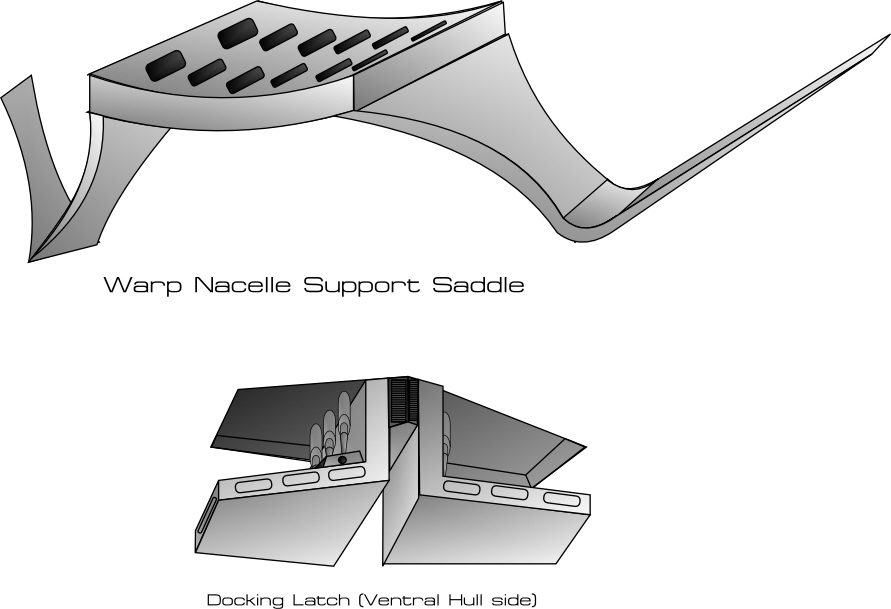
It is COMSTARFLT’s desire as vessels of the Mk XXV class become operational to pull Miranda and Soyuz class ships off the active roster and place into reserve status. The drawback to initial funding and a major point of concern was the radical design of the warp nacelle support pylons which reveal a subtle Klingon influence and gives the vessel a formidable appearance which can be of definite deterrent value. The intention of the new arrangement is to give the Mk XXV increased warp maneuverability and a very much smaller turning radius than a vessel of comparable size. This will be an invaluable asset in ship to ship combat against all threats. The shear forces at critical stress points where the pylons attach to the hull will be negligible due to the nacelle support pylons being fabricated as one piece. It would do to mention that the shear forces at speeds approaching maximum velocity will put minimal strain on the flexible matter/anti-matter power transfer conduits which feed the port and starboard warp nacelle. Exhaustive testing by the Starfleet Warp Dynamics Lab and structural testing of the latching mechanisms has determined that there is a .01% chance of catastrophic failure at critical stress points during performance of radical maneuvers, in other words there is a greater chance of a warp core breach.
Both pylons are attached to the ventral hull by a series of twelve docking latches which provide the necessary physical connections to the load bearing members of the pylon (figure 1). The active side of the latches is located on the ventral hull the passive apertures of the mechanism are located in the pylon support saddle structure. Each active latch segment consists of two spreading grab plates driven by four redundant sets of electrofluidic pistons. The grab plates measure 4.5 x 5.0 m and are constructed of diffusion bonded tritanium carbide, similar to the main load bearing spaceframe members. These are designed to accept and transfer energy from the structural integrity field generators locking the nacelle support structure to the main hull. The ventral surfaces of the grab plates are layered with standard ablative hull coatings for exposure to the general space environment and warp flight stresses. The latching system has been designed to accept a failure rate of 1.5 latch pairs per emergency separation.
Each electrofluidic piston consists of a main fluid reservoir, magnetic valve controller block, piston computer controller, attach brackets, pressure manifolds, and redundant sensor assemblies. Piston operations is maintained under computer control to assure smooth activation of all latches simultaneously, though under emergency conditions a manual latching option is available.
Quick disconnect umbilicals set into the vehicle/pylon saddle interface, which normally allow unbroken energy flow through the flexible intermix waveguide conduits, computer information, and other data channels, are isolated once the separation sequence is initiated.
In the event of catastrophic damage to one or both nacelles, or should it become necessary to dump the warp core, the computer will initiate the procedure necessary to eject the pylon saddle. This will be necessary to prevent cataclysmic damage and possible loss of the vessel to an imbalanced warp field. The computer activates all interface terminations and interconnects to seal off the main hull and a 60 second countdown proceeds. Once initiated the process cannot be stopped. With the addition of the non-propulsive center line nacelle all weapons and defensive systems remain active and online as well as all critical environmental systems.
Another issue encountered early in the design stages was the location of the main navigational deflector. With the proposed design, the forward part of the primary hull was the only logical location. This location accomplishes the task of deflecting microscopic objects which may be in the vessels direction of movement.
Defensive weaponry for the proposed class of vessels includes:
After careful of the design schematics submitted to by the ASDB to meet the desired specifications and demands upon the Mk XXV class by Starfleet Command, COMSTARFLT requested funding for the proposed NX-63164 Tactical Cruiser Project from the Federation Appropriations Committee. Initial funding for the class allowed for the construction of the lead vessel and six others with the goal of stationing these ships at potential hotspots within the Federation. Though originally put forward as a tactical cruiser design, the press quickly grasped on to the terminology of battle cruiser of which they have never been called within official circles. Starfleet Command started calling the NX 63164 design a tactical cruiser and that became its official designation.
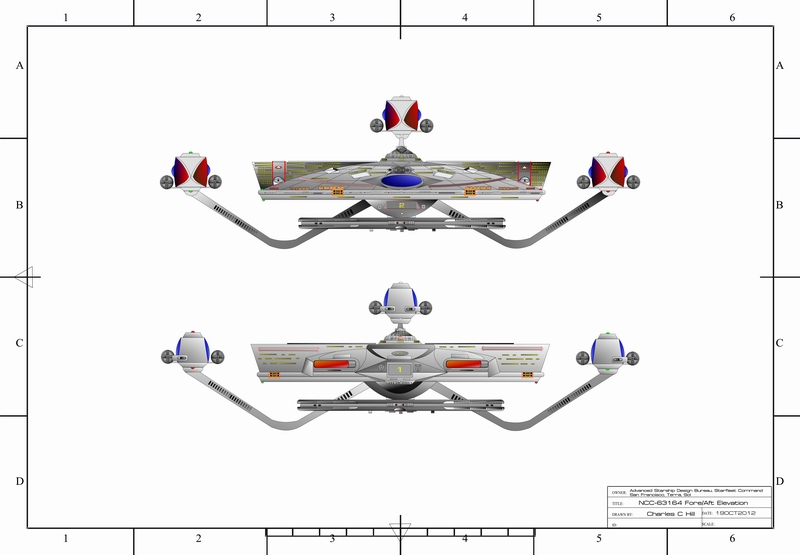
The initial contract for the prototype U.S.S. King George V was awarded to Vicker’s Shipbuilding and Engineering Limited’s Barrow Shipbuilding Works. The construction of the spaceframe began on 6 March 2353 when the first frame members were gamma welded at the Imperial Yards orbiting Europa (Sol Vf) only three years from the design stage and five years behind the Nebula and Galaxy projects. Many of the technologies and experiences gathered from the early work on Nebula and Galaxy enabled the NX 63164 project to move forward rapidly by then construction standards. Three years after construction began the lead ship of the class was launched and after fitting out and trials was commissioned and accepted by Starfleet a year and a half later. By the time of acceptance, three other ships of the class were in various stages of fabrication and construction. The ship is considerably smaller than a Galaxy or a Sovereign, but also costs about a third of the Galaxy to maintain. The shape of the King George V was influenced by her LF-63 warp drive and uses an angular-curvilinear hull shape, which presents a sharply reduced Z axis frontal area. The simplified cross sections make construction quicker and cheaper and the hull and spaceframe is expected to require less rebuilding over the operational life of the ship.
As noted above, Leeding Technologies completed development and testing of their LF-63 variable geometry warp drive system at about the time Mk XXV class was being developed. The LF-63 is optimized for continuous high warp operation on vessels displacing less than 2.5 million metric tons and boasts a 30% greater fuel efficiency than the earlier LF-41 design at speeds in excess of warp 8. The nacelles adjust themselves as needed to maximize the warp field balance. The LF-63 also does away with the harmful effects on local space fabric that has been of increasing concern through certain space lanes.
Performance history All seven ships initially funded were complete and in service prior to the engagement of the Borg at Wolf 359 in 2367. During this encounter, two of the class were destroyed, Collingwood NCC-63165 and Von der Tann NCC-63166 along with many other ships sacrificed during this incursion. King George V was in the Gamma Hydrae sector at the time patrolling the Romulan Neutral Zone and arrived only after the Federation had suffered bitter losses. Derfflinger NCC-63167, Hipper NCC-63168, Agincourt NCC-63169 and Repulse NCC-63170 were all present at Sector 001 when the Borg cube attacked Federation defenses to assimilate Earth ("Star Trek: First Contact"). Based upon the ships performance in combat, which far exceeded design specifications, ten more vessels of the class were immediately ordered. By 2369, Starfleet had shipalt’d the initial surviving vessels with regenerative shielding and quantum torpedo modifications. The new shielding technology came to be called colloquially as “Resistance is Futile” (RIF) shields and had not been placed under combat stress with the Borg prior to the outbreak of hostilities with the Dominion.
When armed conflict with the Dominion came in August 2373, eight of ten ships were in service with the fleet. The ambitious design specifications were placed under stress and proved extremely successful. All active vessels saw varying degrees of combat and all were damaged to some extreme, but four were lost, Hipper, Agincourt, Roma NCC-63173, and Musashi NCC-63175.
At the beginning of the conflict, King George V was initially stationed at Starbase 10 in the Bolarus Sector under the command of CAPT Francis Jebediah LaHood patrolling the Romulan Neutral Zone. Though the Romulan Star Empire had signed a non-aggression pact with the Dominion and Cardassian forces, Starfleet did not expect for the Romulans to sit idly by, they were at this time allowing Dominion forces free access through their space. This latent threat to the Federation flank kept valuable resources tied down, which is what the Dominion planned. Numerous border incursions were discovered using the tachyon detection grid first implemented by Enterprise NCC-1701-D against the Romulans in 2368. As combat losses in the war grew heavier, King George V was transferred from Starbase 10 to Seventh Fleet. She arrived in time to participate in the attempt to prevent Dominion forces from occupying the Tyra System in early 2374. During that massacre, 98 of 112 ships were lost or beyond repair, King George V with her impressive armament and incredible staying power was personally credited with destruction of 5 Jem’Haddar cruisers and one Cardassian Galor type vessel. This earned King George V her first Federation Battle Star. Later that same year, after conducting repairs, King George V was again engaged with enemy forces at Sybaron. During the first year of the war King George V was dispatched on a diplomatic mission to ferry Ambassador Spock to a meeting in Romulan space to persuade the Praetor to join the alliance against the Dominion. Ultimately, this method of diplomacy failed and resulted in CAPT Sisko of Deep Space 9 to coerce the Romulans to join the conflict through subterfuge.
As the war progressed through late 2374, Tirpitz NCC-63174 provided heavy fire support in the successful mission to prevent breaching of the Bajoran wormhole and the subsequent recapture of DS9 by Cardassian forces. King George V again saw combat with her sisters Dunkerque NCC-63171 and Kongo NCC-63172 against Cardassian and Dominion forces in the Kalandra sector. All three ships suffered damage during the withdrawal of Federation forces from the area which consequently allowed the Dominion to threaten the Federation Core worlds. During this action to prevent the loss of Betazed, Hipper was lost with all hands as did several other vessels falling victim to the Breen energy dampening weapon. Hipper alone was not the only ship of this class to be outmatched by the Breen, Agincourt and Roma were lost with over three hundred other vessels at the Second Battle of Chin’toka in early 2374.
Besides combat duties there were the inevitable convoy escort missions against Ferengi traders conducting illicit commerce with Cardassian and Dominion forces, pirates, and the ever present marauders within the war zone. These patrols, though necessary, provided a needed respite to an exhausted crew. In April 2375, a new offensive was launched to retake the Kalandra sector and King George V, Dunkerque, Shilo NCC-63176, and Antietam NCC-63177 were assigned to Seventh Fleet to participate. The last engagement of the war was the Battle of Cardassia Prime and it was during this assault that Musashi became the last vessel of the class to be lost to action with an enemy.
During the Dominion War, and amongst the vast areas in which it was waged, vessels of the King George V class were always in great demand. No other ship within Starfleet could provide such devastating fire; the six phaser cannons alone could knock down the shields of many vessels on the first volley. The power provided by the center line warp engine dedicated to weapons and shields, ensured a minimal recharge time for both systems. The class validated the foresight envisioned in their construction and fabrication and solidified their positions in the future of Starfleet operations. As construction progressed through various stages the heredity of the design can easily be traced back to the Miranda class. It seems only fitting that a class of ship, which can easily be argued as one of the most successful designs in Starfleet history, should live on.
Kitty Hawk
Class
 Design by Jeff
Nielsen
Design by Jeff
Nielsen
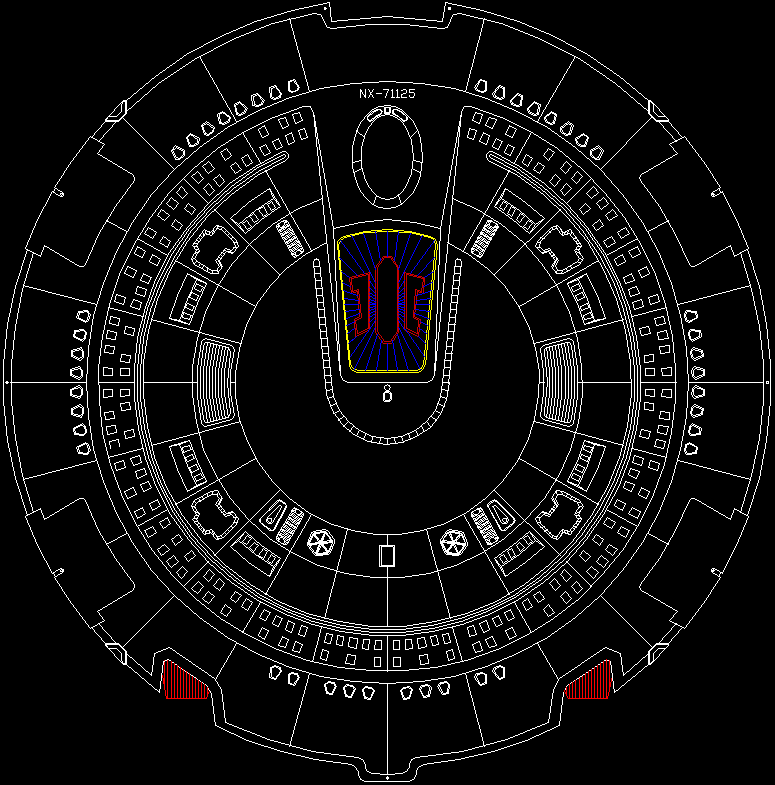
USS Kitty Hawk NX-71125
Type: shuttle carrier
Commission Date: June 19, 2374
Beam: 500.00m
Length: 507.06m
Height: 66.70m (without warp nacelles); 95.75m (with warp nacelle assembly)
Decks: 16
Max. Sustainable Speed: Warp 9.1, unlimited duration; Warp 9.98 for 12
hours
Normal Cruising Speed: Warp 7.50, unlimited duration
Crew complement: command crew: 85
Engineering crew: 165
Mission ops crew: 125
Science crew: 75
Marines/flight crew: 150
Total: 600
Total evac limit: 2000
Ship systems:
Warp Drive: 2x Cochrane Warp Dynamics LF-44, 1x Port and 1x Starboard feeding into a Plasma Phase Discriminator. The plasma is then balanced and feed to the two
warp nacelles.
Impulse engines: 2x Kloratis Fig-5 Engines in the Primary Saucer section, plus 2x Kloratis Fig-4 Engines inside the
warp nacelle housings.
Weapon system: Phaser: 3x Multi-Focus Auto-Retuning HiBeam Energies Type XII Emitters
Weapon system: Photorp: 3x Skat-Rar Mk 95 Quantum Torpedo Launcher, retrofitted to fire Transphasic (Janeway's Alternative Future), Photon, Quantum Torpedoes and
Standard Probes.
Weapon system: Nog X-1 Auto-Replicating (non-cloaking) Mines.
Defensive system: Charlottes Shields FSQ and Starfleet J-01 (Janeway's Alternative Future) Ablative Armor Generators.
Computer system: Primary: DSC M-16 Bio-Neural Gel Pack Isolinear III.
Computer system: Navigational Suites: Tlixis Ramab RRB RAV/ISHAK Mk 4
Computer system: Fire Control: RCA AEGIS Mk 8 Mod 1 Multi-Focus Targeting Array
Life Support system: Morris Magnatronics MM6 Modular Gravity Unit and A'Alakon Landis AL4 Multi-Species Life support
systems
Other systems of note:
Emergency Transverse Bulkheads
4x Multi-Spatial Long Range Warp Probes
Enhanced Ferengi Metaphasic Shielding
Holo-Enhanced Ship Stations: All main ships stations and crew community rooms (as well as a number of main corridors) are equipped with dedicated EMH
holoprojectors, such as the Main Bridge, all Personnel Transporter Rooms, Main Engineering, Astrometrics, all mess-halls, Warp Nacelle Monitoring Stations,
Captain's
Ready Room, Observation Lounge, etc..
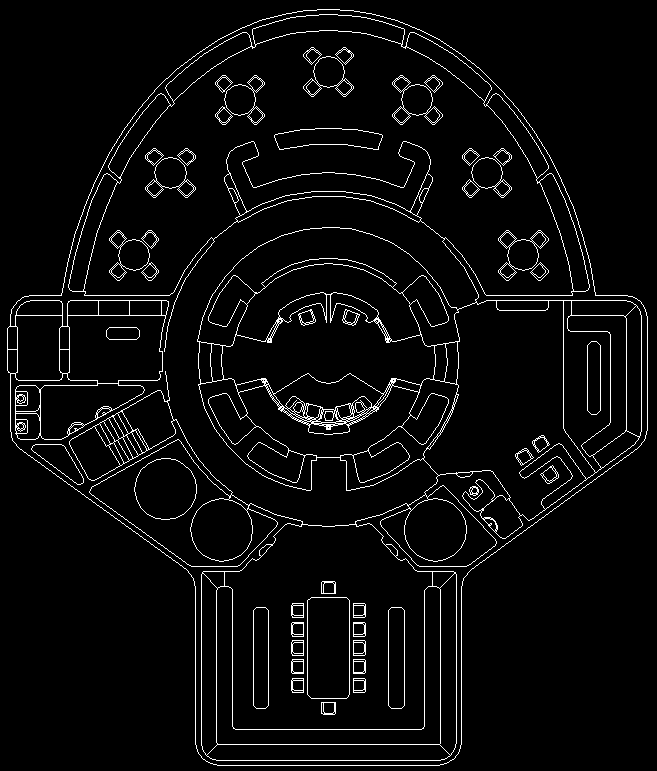
Holo-Enhanced Bridge Stations : One of the most complex innovations is the inclusion of the new bridge module. Replacing the older bridge
whose layout did not fit well with military operations, is the new Holo-Bridge. A complex dedicated computer core from a damaged Danube Class Runabout has been installed in the bridge to run the
Holo-Matrix. In combat situations the bridge of the Kitty Hawk is replaced with a 360 degree panoramic holographic projection of the surrounding environment. The
Holographic representation is a 'flat' screen approach to holography in that the images remain on the walls and surfaces they are projected on, however at any point in the
bridge and officer can look 'out' into space and see what is happening. The recessed bridge stations allow the command staff to have an uninterrupted view of the
surrounding space, while not interrupting the chain of command. Each of the recessed bridge stations also has a view of over 200 degrees, not the complete 360 of the
command staff. The two aft bridge stations are tactical stations, although both are only used in high combat situations. the aft port and starboard stations are mission ops
stations, the fore port and starboard stations are engineering (port) and science (starboard), but can be reconfigured into tactical stations if needed.
Auxiliary craft: The U.S.S. Kitty Hawk Carrier is equipped with a standard compliment of shuttles and EVA pods. However in combat situations or when expecting hostile activities the U.S.S. Kitty Hawk can dock at the closest starbase and switch her normal shuttle compliments to a suite military operations or rescue operations. All three shuttlecraft compliments are listed here.
Standard configuration:
80x Type 9 Shuttlecraft
24x Type 11 (Enterprise E Class) Shuttlecraft
18x Danube Class Runabout
12x Type 16 Shuttle Pods
32x Worker Bee Class EVA Pod
Rescue Configuration:
80x Type 9 Shuttlecraft
42x Danube Class Runabout
12x Type 16 Shuttle Pods
32x Worker Bee Class EVA Pod
Military Operations:
80x Type 9 Shuttlecraft
24x Valkryie Class Superiority Fighter
12x Valkryie Class Bomber Variant
6x Danube Class Runabout
12x Type 16 Shuttle Pods
32x Worker Bee Class EVA Pod
History The U.S.S. Kitty Hawk was originally commissioned as a long range Shuttle Carrier, envisioned in a support and rescue role she was pressed into military operations when the Borg attacked. Returned to her original configuration after the Borg Incursion into Sector 001 she saw a few years of peace as a medical, cargo and rescue ship. Then the Dominion invaded and again her configuration was altered, and she was pressed into service as a military carrier. With the Dominion threat over, the Cardassians contained within their own space and the Klingons rebuilding their empire, it appeared that the Kitty Hawk would again be returned to her original configuration. However Starfleet Command has decided to keep her in her military configuration for the moment. This was decided because of Starfleet Intel pointing to a possible Romulan offensive. So with the short period of peace the Federation is again enjoying, the Kitty Hawk is undergoing field repairs and upgrades. Not the least of which is the new technology the U.S.S. Voyager returned with. After studying the armor and weapons technology brought from the future, as well as the alien technological innovations discovered in the Delta Quadrant, the U.S.S. Kitty Hawk is being quickly retooled and rebuilt. Her systems hare now being 'hardened' to meet military standards.
Lacuna Class
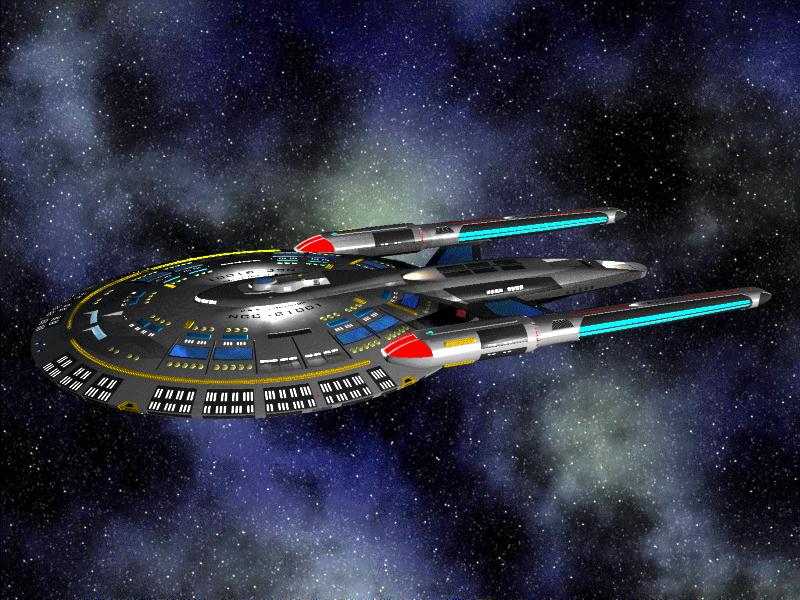
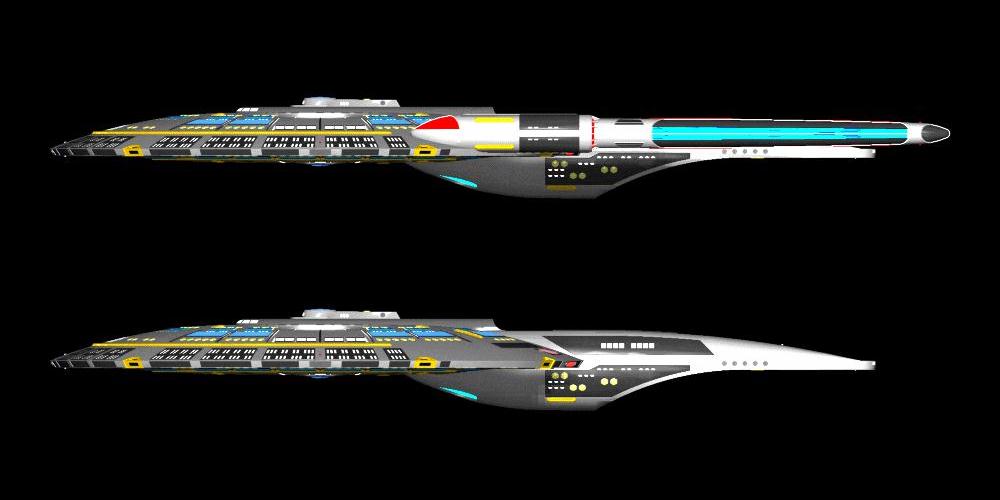
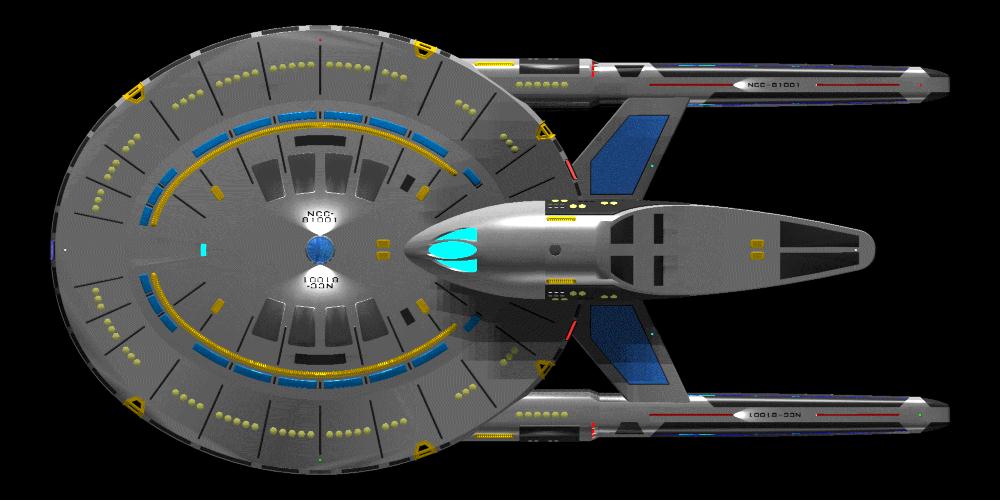
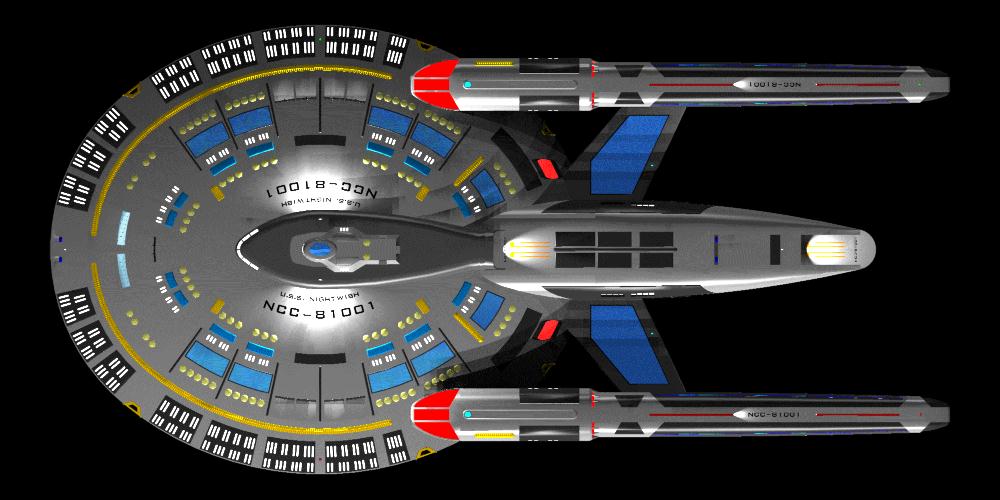 Design by Robert Heckadon
Type: Medium explorer
First commissioned: Stardate
68987.0
Length: 450m
Width: 225m
Height: 51m
Decks: 16
Displacement: 1,700,000t
Complement: 100 officers + 350 crew, evacuation limit: 9500
Speed: Warp 8 (cruise), Warp 9.9985 (max.), Warp 9.9995 (max. emergency)
Sublight speed: 0.9c (max.)
Armament: 12 type 16 phaser arrays, 4 photon/quantum torpedo launchers
Defense: Regenerative shields, SIF enhanced hull plating (backup)
“Somewhere there my fate revealed; I hear but how will I see” - The Siren by Nightwish
The Lacuna class starship is Starfleet’s newest medium class exploration cruiser. Built more than 10 years after the Scimitar incident, the Lacuna is designed so that almost every duty compartment, such as science labs and sensor arrays on the ship can be used for both scientific and military application, reducing the amount of refit time needed. The lower saucer contains 8 replaceable cargo modules. These modules not only can be replaced for cargo that require specific environmental conditions, but can also be replaced with missions specific modules for either military duty or scientific discovery.
Almost every crew member ranging from engineer to scientist has some MACO combat training closely related to their field of study. This maximizes crew efficiency during hostile situations. And each crew member has a secondary field of study should they be needed for backup for another department. Like medical for engineering. With the multiuse structure of the Lacuna and the training of its crew, it can perform missions exceeding those of a Galaxy class starship.
As with the Lightyear class, the Lacuna class uses a hybrid dilithium crystal at the heart of the primary antimatter reactor. It uses 95% of conventional dilithium and 5% of an artificial version of the dilithium crystal that was discovered in the Delta quadrant by the U.S.S. Voyager on stardate 49373.4, which allows ship to travel at warp 10. This dilithium hybrid allows the ship to travel at the remarkable warp 9.9985 for 20 hours, and warp 9.9995 for almost an hour. Placed on the ship’s upper saucer section and the nacelle pylons are 14 solar collectors. They are normally used to augment the ship's power reserves.
One of the unique feature of the Lacuna class is that is has a forward firing impulse engine to reverse impulse thrust or to bring the ship to a full stop (1). Traditionally reversing thrust involves channelling the impulse power to the driver coil assemblies only, and venting the exhaust gas in a non-propulsive order. This reduces the ships apparent mass, and therefore reducing the force requirements enough to vent gases from the Bussard ramscoops to provide sufficient reverse thrust (2).
But venting gases from the ramscoops for propulsion uses significant amounts of fuel and can cause a disruption in the deflector shields because the venting is un-modulated and disperses in all directions. Although the shields can still withstand phasers and torpedoes, they are somewhat vulnerable to high impact collisions, such as with another starship. By adding on a forward engine, whose exhaust can be modulated and focused, those weaknesses can be significantly reduced. And the power of the impulse engine can be used to increase the kinetic yield of a forward firing quantum torpedo, or serve as a backup power source. The ship also uses an old style M2P2 electromagnetic sail, located on the pylons, for deceleration while entering a star system. The Lacuna class is the first starship to use a liquid crystal medium to transfer power less than 25 GW throughout the ship that the EPS conduits do now. Everything over 25 GW still uses standard EPS conduits.
The Lacuna was originally suppose to use a phase distortion generator to “open” its shuttle bay doors by temporarily making them “disappear,” and reappear when it came time to close them. However, due to technical problems, energy usage, structural fatigue, and the death of an engineering team has lead to both shuttle bays to be refitted with single piece sliding doors.
To provide and effective defence, yet not to unintentionally show hostilities to a somewhat xenophobic alien culture, the Lacuna class is only armed with 2 transphasic torpedoes. Enough to disable a Borg cube. However the ship is still armed with 400 photon torpedoes, and 100 quantum torpedoes. Aside from the military hardware, the ship boasts nearly 50 science labs, 10 conference rooms and a multi-spectral astrometrics sensor array located at the bottom of the saucer section.
Currently Starfleet has only 3 Lacuna class starships in service:
U.S.S. Lacuna (NX-81000)
U.S.S. Nightwish (NCC-81001)
U.S.S. Reliant (NCC-81002)
with 2 more already under
construction:
U.S.S. Lancaster (NCC-81003)
U.S.S. Tucker (NCC-81004)
and 10 more unnamed ships already contracted for construction.
Though they still have yet to be installed, these ships have hardware connections for an exotic matter drive. Which is an exotic matter particle beam emitter that can open a wormhole that exists between 2 black holes.
With the Lacuna class starship, as with many other exploration star cruisers before them, they will be paving the way for both the defence of the Federation, to explore strange new worlds, and encounter phenomena that goes beyond the imagination.
Reference notes:
(1) - Due to the complex dynamics of space, the term “full stop” refers to either maintaining the same distance from an object of interest, or “full reverse” with much greater urgency in a combat situation.
(2) - One of the functions of the driver coil assembly is to reduce the apparent mass of the spacecraft at its inner surface. And thus less force is required to accelerate the ship.
Star Trek: The Next Generation; "Preemptive Strike"
Star Trek: The Next
Generation; "All Good Things"
Star Trek: The Next Generation Technical Manual
Star Trek:
Voyager; "Threshold"
Star Trek: Voyager; "Basics, part 2"
Star Trek:
Voyager: "Endgame"
Star Trek: Nemesis
http://www.ess.washington.edu/Space/M2P2/
Lance Class
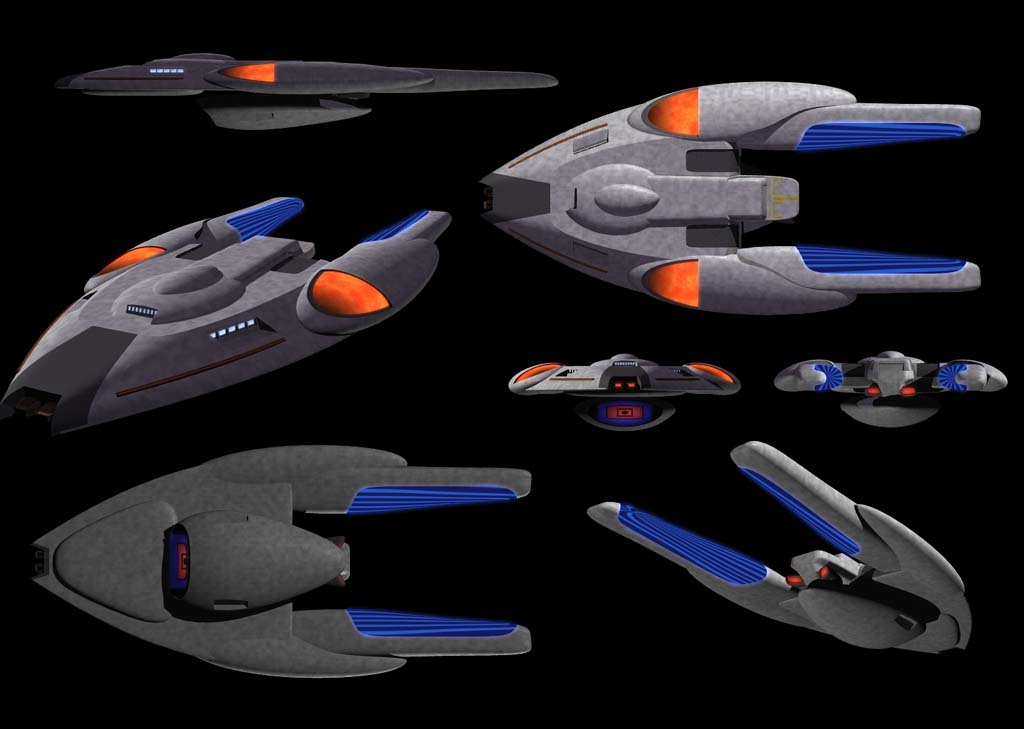 Design by Kenny, ASDB Member
No specs available
A design inspired by Lance's Chimera
Leaf Class
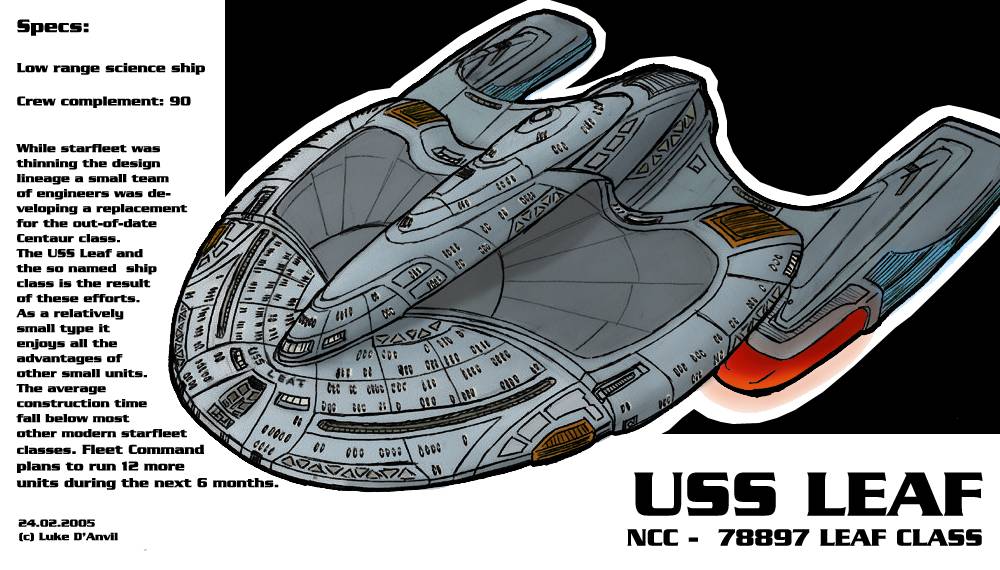 Design by Luke D'Anvil
Type: Low range science ship
First commissioned: 2384
Length: 320m
Width: 260m
Height: 60m
Decks: 14
Displacement: 980000t
Complement: 15 officers + 75 crew, evacuation limit: 270
Speed: Warp 8.5 (cruise), Warp 9.0 (max.), Warp 9.75 (max. emergency)
While Starfleet was thinning the design lineage a small team of engineers was developing a replacement for the out-of-date Centaur class. The USS Leaf and the so named ship class is the result of these efforts. As a relatively small type it enjoys all the advantages of other small units. The average construction time fall below most other modern Starfleet classes. Fleet Command plans to run 12 more units during the next 6 months. The sister ship of the USS Leaf, the USS Lothlorien became heavily damaged recently in a surprising fight with a ship of the dead-believed Orion syndicate.
Leander Class
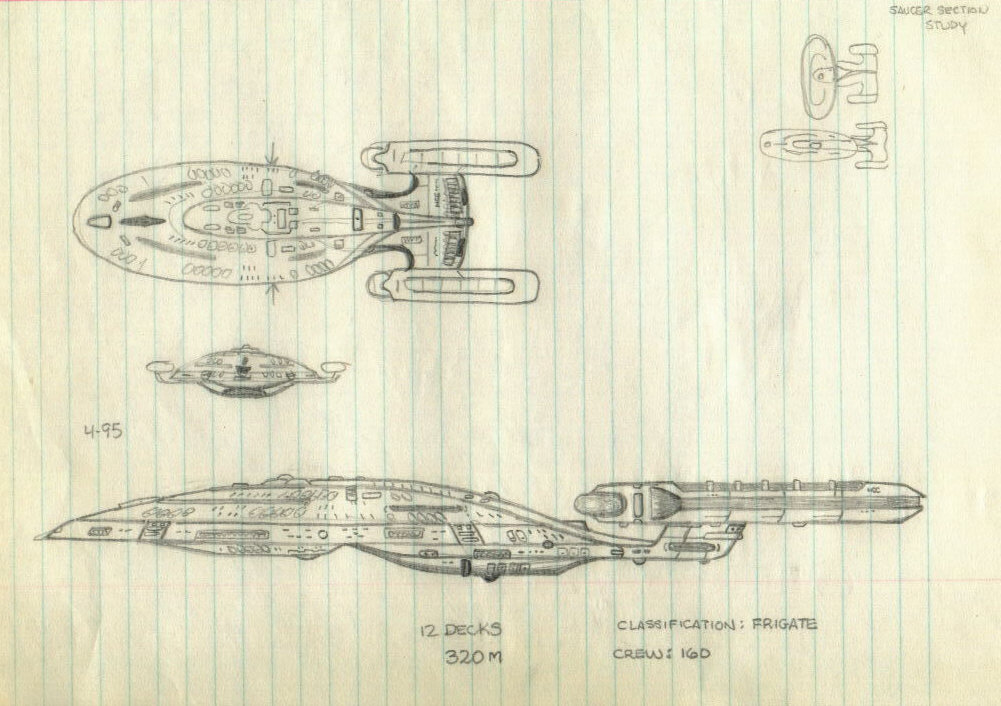 Design by James Donovan
Frigate
Length: 320m
Decks: 12
Crew complement: 160
No description
Leif Ericsson
class

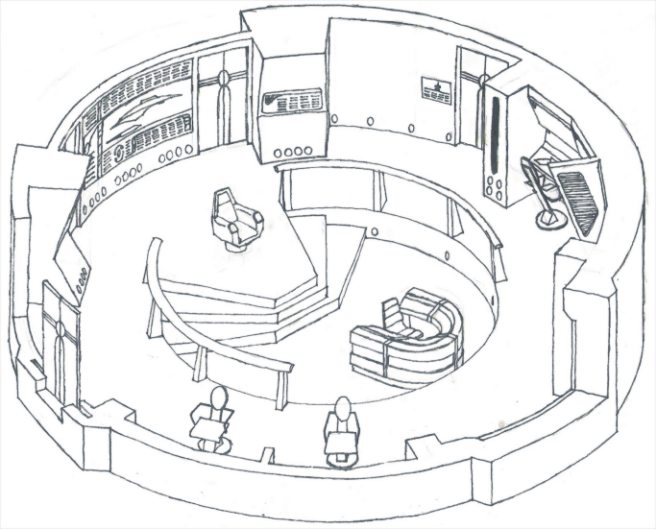
 Design by Starhawk
Type: Explorer
First commissioned: 2378
Length: 206m
Width: 96m
Height: 42m
Decks: 21
Complement: 21 officers + 310 crew
Speed: Warp 5 (cruise), Warp 9 (max.), Warp 9.9 (max. emergency)
Sublight speed: 0.25c (max.)
Armament: 10 type-11 phasers, 1 dedicated quantum-torpedo launcher, 4 photon/quantum torpedo launchers
Defense: 11.5cm armor plating, envelopment deflector shield, emergency hull plating polarization system
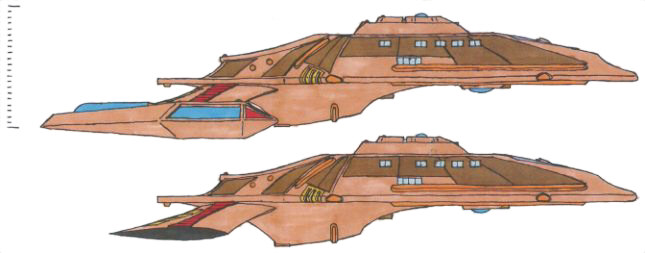
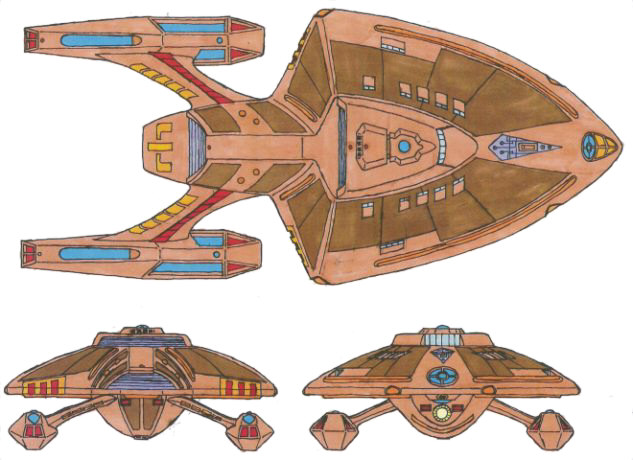
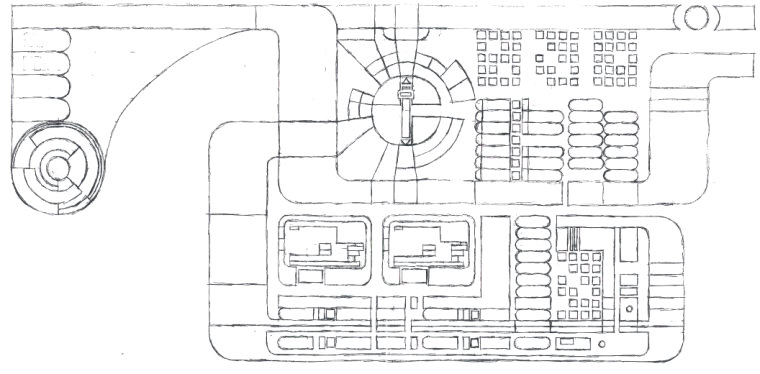
The USS Leif Ericsson was built in 2378, after the Intrepid and Sovereign classes. Her design profile is similar to the Titan class; she is a fast ship, designed to handle nearly anything: reconnaissance, patrol duty, exploration, military ops, science missions, the Leif Ericsson class can do it all. The USS Leif Ericsson, being the first of her class, has been put through a long shakedown cruise; her systems are top of the line (and some are even a little beyond that) and all testing indicates that actual performance will exceed expectations significantly.
 The Leif Ericsson class is yet another ship designed to replace the Galaxy
class; of all of them, this is the one that is most capable of succeeding in that massive task.
The engineers on the Leif Ericsson class project did their homework and used advanced (and, occasionally, experimental) technology to do what their predecessors never could:
design a ship that did the same amount of work as a Galaxy-class vessel in about than half the space. The
Leif Ericsson class is almost one-third the length of the Galaxy and
has exactly half the decks. Experimental automation technology and more sophisticated programming, ship AI, and other new developments allow for a crew of only 531, with
thirty-one of them being officers.
The vessel boasts a state-of-the-art, experimental T/LCARS (Touch Library Control/Access Retrieval System) system that, while touch-operated in a similar fashion to the TCARS
system on the original Constitution class vessels and earlier ships, still accesses a central library of information that can be accessed and used freely by all personnel
(with proper clearance, of course). This, coupled with the newest of Starfleet's ship AIs and higher levels of automation, forms the core of the
Leif Ericsson class's versatility. The new AI is able to cope with nearly any demand, from an evasive maneuver to getting an effective shot off at the Borg to a cup of steaming hot Earl Gray tea. The T/LCARS system is more versatile than
a standard LCARS while simultaneously being almost as responsive as a purely TCARS system would be. The increased automation results in a lower number of required personnel
who must put their lives on the line; while Starfleet has no shortage of new recruits, it does tend to reduce the number of tragic letters of condolence.
The Leif Ericsson class is yet another ship designed to replace the Galaxy
class; of all of them, this is the one that is most capable of succeeding in that massive task.
The engineers on the Leif Ericsson class project did their homework and used advanced (and, occasionally, experimental) technology to do what their predecessors never could:
design a ship that did the same amount of work as a Galaxy-class vessel in about than half the space. The
Leif Ericsson class is almost one-third the length of the Galaxy and
has exactly half the decks. Experimental automation technology and more sophisticated programming, ship AI, and other new developments allow for a crew of only 531, with
thirty-one of them being officers.
The vessel boasts a state-of-the-art, experimental T/LCARS (Touch Library Control/Access Retrieval System) system that, while touch-operated in a similar fashion to the TCARS
system on the original Constitution class vessels and earlier ships, still accesses a central library of information that can be accessed and used freely by all personnel
(with proper clearance, of course). This, coupled with the newest of Starfleet's ship AIs and higher levels of automation, forms the core of the
Leif Ericsson class's versatility. The new AI is able to cope with nearly any demand, from an evasive maneuver to getting an effective shot off at the Borg to a cup of steaming hot Earl Gray tea. The T/LCARS system is more versatile than
a standard LCARS while simultaneously being almost as responsive as a purely TCARS system would be. The increased automation results in a lower number of required personnel
who must put their lives on the line; while Starfleet has no shortage of new recruits, it does tend to reduce the number of tragic letters of condolence.
The Leif Ericsson class's offensive, defensive, and intelligence equipment is extensive as well. Ten Type-11 phaser strips allow for full coverage of the ship's area: the ship can fire in literally any direction. A quantum torpedo turret in the ventral sensor dome area, similar to that of a Sovereign class vessel, can fire up to 120 torpedoes per minute, and draws from its own magazine of 32 quantum torpedoes. The vessel boasts an additional four quantum-compatible photon torpedo launchers, which can launch one torpedo per second (half the speed of the turret) and draw from four magazines: fore and aft quantum torpedo magazines of 64 torpedoes each, and fore and aft photon torpedo magazines of 128 torpedoes each.
In addition to a septuple-layer enveloping deflector shield (Starfleet standard), the Leif Ericsson class boasts an 11.5cm-thick rhodinium-duranium hull, and an emergency backup polarization system, ancient technology that still works in a pinch, can generate an electromagnetic field that causes the 11.5cm armor plating to act as if it were 25.5cm thick; however, the armor plating system requires the equivalent power of a cruise at W/F 4. This means that a damaged warp core may be unable to power the polarization system fully, and the system cannot be used during warp at all.
The intelligence-gathering equipment starts with a Starfleet-standard (state-of-the-art) communications and sensor package and goes straight up from there. A dedicated sensor array on the saucer front, similar to those on the Nova and Intrepid classes, provide a powerful aid to understanding planets and interspatial phenomena. Eight specialized science labs, in addition to a stellar cartography lab, further enhance the Leif Ericsson class's science capability.
The engine systems on the vessel would turn any Galaxy-class vessel green with envy. Based on the Defiant class's engines as well as those of the Intrepid class, the matter/antimatter reactor is capable of outputting up to 700 terawatt-hours (equivalent to 700,000,000,000 kilowatt-hours) at peak, necessary to reach the Leif Ericsson class's rated emergency speed of W/F 9.9. The class's Impulse engines are no slouch either, capable of going from Orbital Velocity to 1/4 light speed in under four seconds; however, this is not recommended for the obvious reason that it would provide a significant jolt to anyone and everyone onboard.
The overall design of the Leif Ericsson class is one of extreme versatility, advanced technology, and overall elegance that, even when sitting still in drydock, conveys the impression of an animal about to leap into a fast sprint. The Leif Ericsson class is a truly powerful design that will power Starfleet into the future for some time to come.
Liberty Class
 Design by Chris Talbot
Type: Deep
space explorer
Commissioned: since 2378
Length: 907.37 m
Beam: 381.16 m
Draft: 117.11 m
Decks: 37
Mass: 4,295,227 metric tons
Speed: Warp 8 (cruise), Warp 9.985 (max. sustainable), Warp 9.99 (max.
rated)
Crew: officers - 260, non-commissioned officers - 642, civilian mission specialists - 5-10,
civilians - 150-200 (facilities for up to 230)
The Liberty-class was designed to augment and, if needed, replace the Galaxy-class starships as deep space explorers. Due to the recent Borg and Dominion hostilities the tactical systems have been greatly improved and are rated at approximately five times that of a Galaxy-class starship. This is complemented by highly advanced scientific systems which allows the Liberty class to be much more proficient in this area than any other starship currently in production.
Lightyear
Class

 Design by Robert
Heckadon
Design by Robert
Heckadon
Type: Explorer
Length: 535m
Width: 250m (nacelles); 220m (saucer)
Height: 42m without module
12 Decks excluding optional module
Speed: Warp 8 (std. cruise), Warp 11 (max. cruise), Warp 13.6 (12 hours),
Warp 13.9 (1 hour), all warp speeds according to recalibration proposal of
2371
Armament: 10 Type-12 phasers, 4 photon/quantum torpedo launchers
Crew: 500 officers and crew; 8000 person evacuation limit
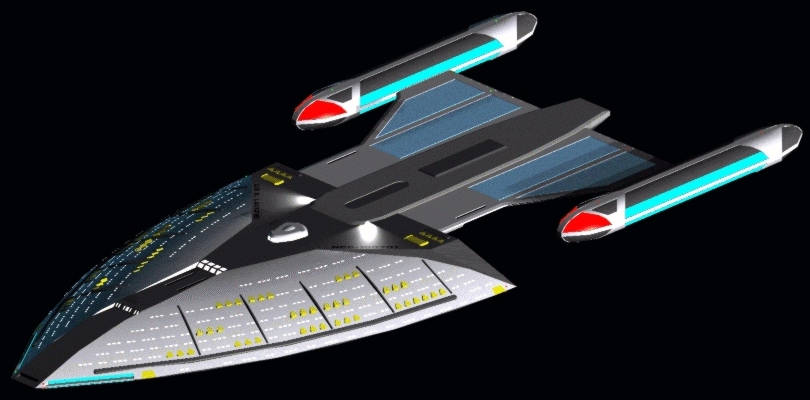
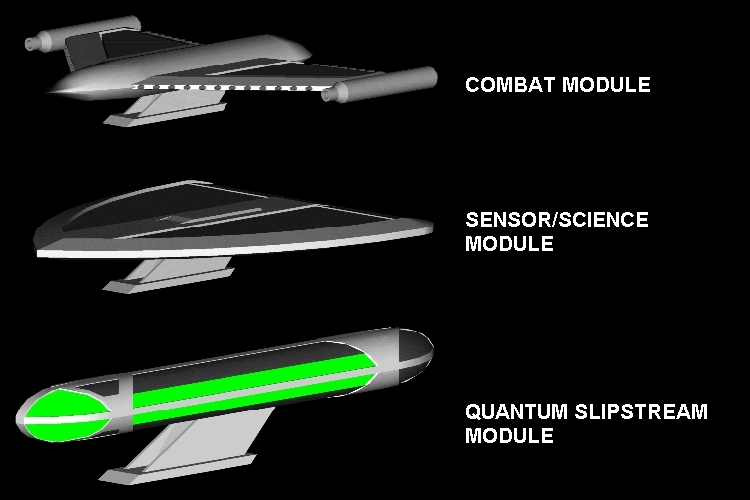
Description The Lightyear class starship is the latest in exploration cruisers, equipped with the latest technological advances. The ship has been designed with an attachment port for different mission specific modules, similar to the Nebula class starship. The 3 primary modules are science and sensors, combat, and quantum slipstream.
 In
reality, there is nothing exotic about the warp nacelles themselves,
standard warp coils to the Prometheus class. However, the warp core itself
is unusual. The dilithium crystal at the heart of the core is a special
form of dilithium. It is a hybrid crystal composed of 99.5% conventional
dilithium and 0.5% of super dilithium, discovered and retrieved by the
U.S.S. Voyager, that can send a ship to infinite warp speeds. The low
percentage of the super crystal is due to both limited supply of the
crystal, and the mutation effects it can produce among the ship and crew.
But even that 0.5% was enough to triple the maximum warp speed of the
Lightyear, while reducing its power usage by 30%. The warp core itself was
designed to cancel out the quantum resonance of the hybrid crystal which
would tear apart the warp core of a Sovereign class starship within
seconds. Though there is little risk of overheating the engines, the
strain on the structure limits the Lightyear to warp 13.9.
In
reality, there is nothing exotic about the warp nacelles themselves,
standard warp coils to the Prometheus class. However, the warp core itself
is unusual. The dilithium crystal at the heart of the core is a special
form of dilithium. It is a hybrid crystal composed of 99.5% conventional
dilithium and 0.5% of super dilithium, discovered and retrieved by the
U.S.S. Voyager, that can send a ship to infinite warp speeds. The low
percentage of the super crystal is due to both limited supply of the
crystal, and the mutation effects it can produce among the ship and crew.
But even that 0.5% was enough to triple the maximum warp speed of the
Lightyear, while reducing its power usage by 30%. The warp core itself was
designed to cancel out the quantum resonance of the hybrid crystal which
would tear apart the warp core of a Sovereign class starship within
seconds. Though there is little risk of overheating the engines, the
strain on the structure limits the Lightyear to warp 13.9.
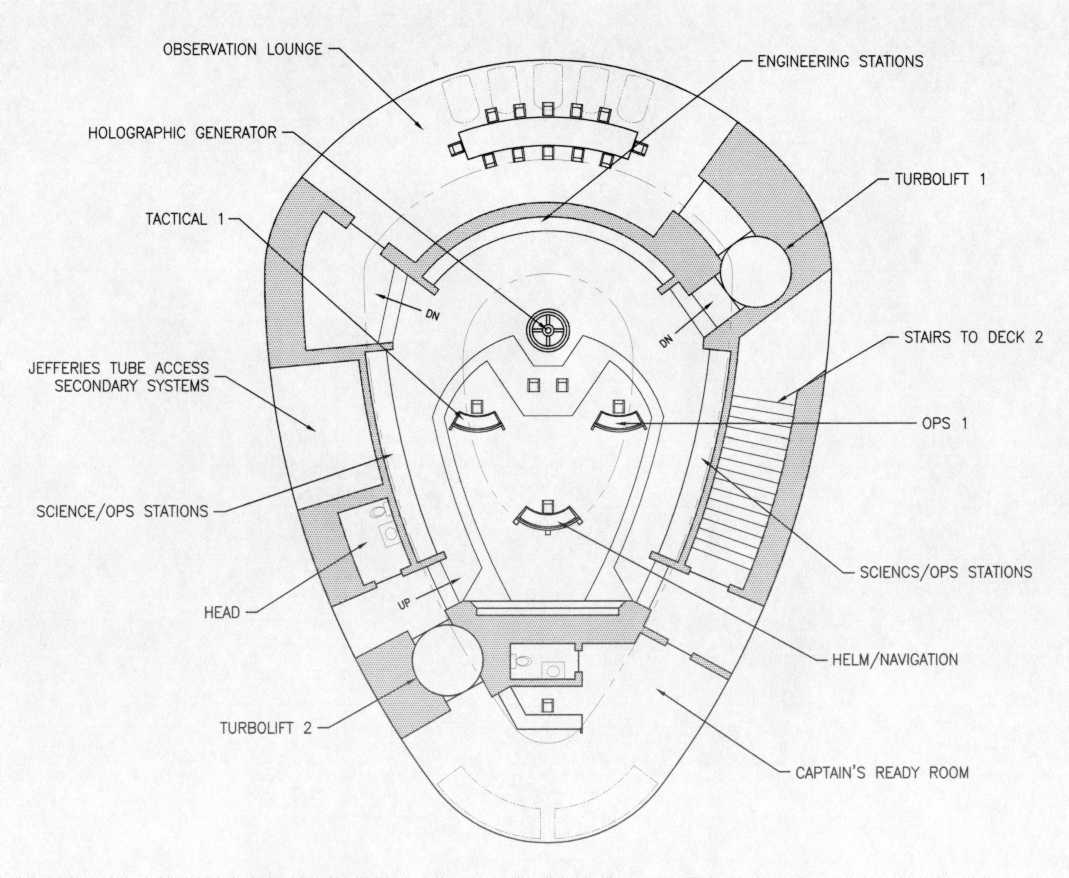
The new navigational deflectors are designed in a similar fashion to the ship's phaser arrays. In other words, instead of using a large scale turret, which is moved by equally large scale hydraulics, the new deflectors use energy fields to direct the deflector beam without using moving parts. This reduces the ship's mass and maintenance time by a noticeable amount. The main deflector arrays can also double as phasers if needed. The backup deflector on decks 11 and 12 still uses traditional designs.
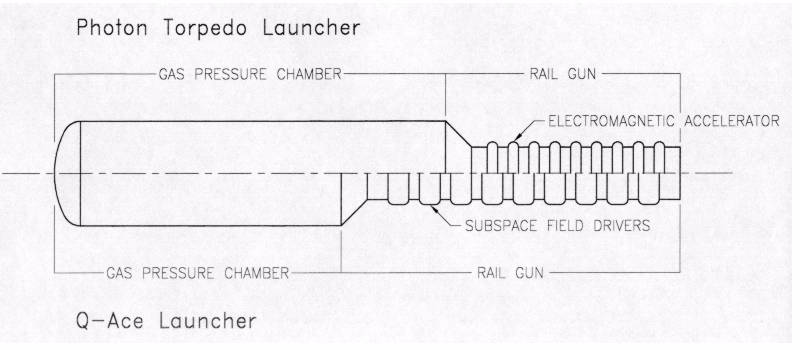
On the outboard sections of the combat module lie the ship's two "Quantum Acceleration Torpedo Launcher" or Q-Ace launcher. In simplest terms, the Q-Ace launcher is a kinetic weapon, like a mass driver. Photon and Quantum torpedoes carry a warp sustainer engine that allows the torpedoes to remain at warp speeds when they are fired at warp. The rail gun of a standard torpedo launcher uses electromagnetic coils to accelerate the torpedo to high impulse speeds. In a Q-Ace launcher, the EM coils of the rail gun have been replaced by subspace accelerators, similar to warp engines. Making use of the warp sustainer engines in the torpedoes, the launcher accelerates a torpedo to Warp 3. When used at sublight speeds, the relative kinetic energy yield of a torpedo would be more than 1000 times the total explosive yield of a quantum torpedo traveling at the speed of light, while the new launcher uses only 10 times the power of a standard torpedo launcher. Since the Q-Ace launcher is not considered to be a true subspace weapon, the Khitomer Accords have no real effect on the new launcher.
Locust Class
 Design by GIF_Basher Lives
No specs available
No description
Los Angeles Class
 Design by Jason Abbadon
Type: Frigate
Length: 328m
Width: 215m
Crew: 220 (12 command officers)
Engine data: 2 warp nacelles, 2 Hyper Impulse engine systems, one warp
core, one reserve warp core
Weapon systems data: Seven Type-X phaser arrays covering all arcs, eight dual purpose torpedo launchers capable of firing
quantum or photon torpedoes as well as science probes. Four covering the forward and four
covering the aft arcs.
Two prototype Emergency Security Holograms, one Mark-IV EMH.
Defensive systems: regenerative shielding and limited ablative armor on key systems (torpedo magazines, launchers, bridge and engines)
Embarked craft: Three Type-10 shuttles, Three Type-9 shuttles, two Type-18 shuttles, four
workbees
Number constructed: three (Los Angeles, Miami, Scorpion) with 52 slated for construction within five
years
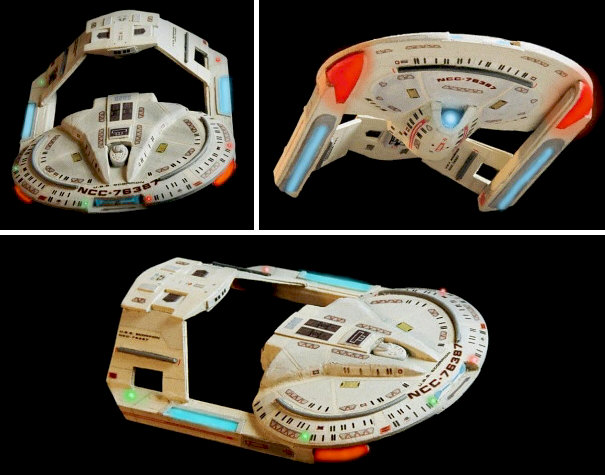
The USS Scorpion is a Los Angeles-class frigate and is the fifth ship of this new class (Los Angeles, Miami, Typhoon and Nautilus preceding her). Designed as a fleet-wide replacement for the New Orleans (over the next fifteen years) as Starfleet's main frigate and tactical starship, the Los Angeles class incorporates many of Starfleet's latest designs into a mid-sized spaceframe with weapons systems found in larger starship designs.
Lusitania Class
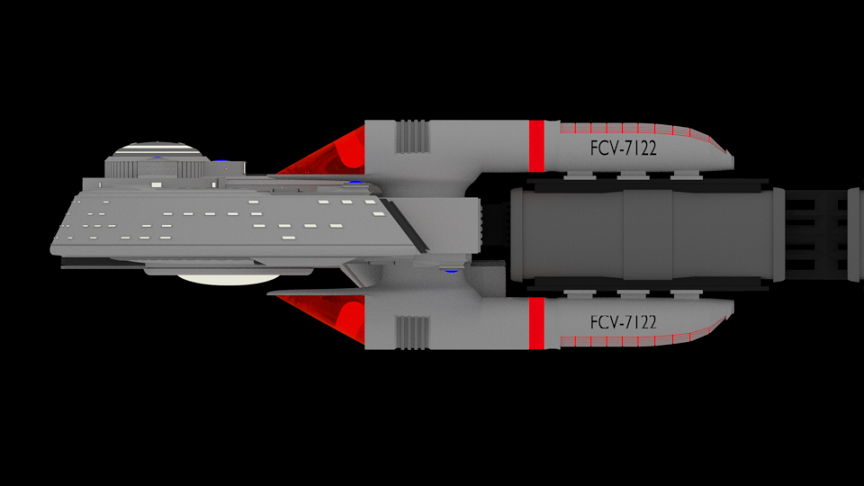
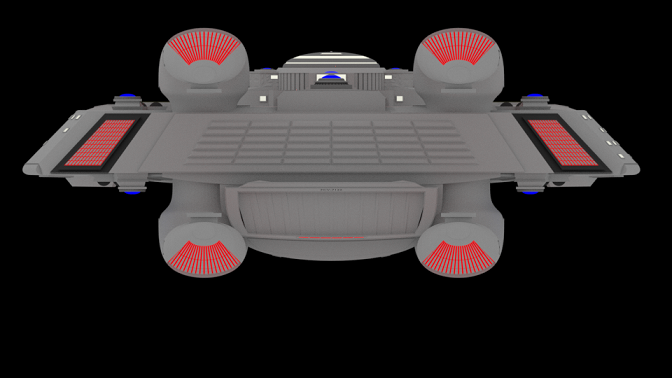
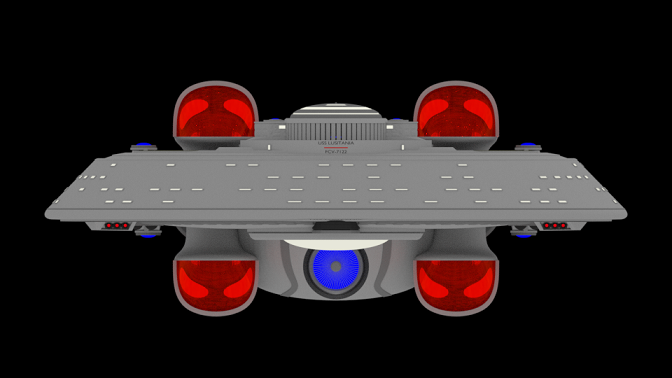
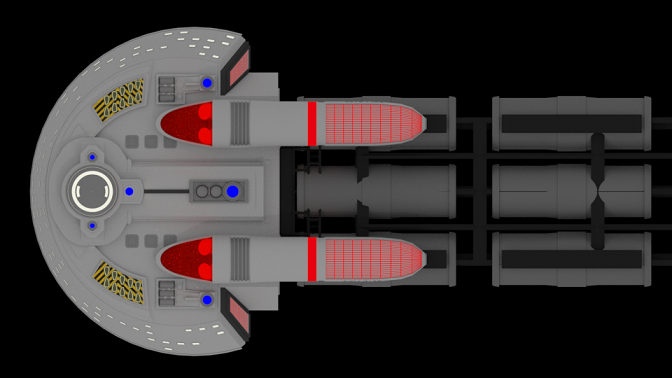 Design by Gregory Starr
Type: Freighter
First commissioned: 2362
Length: 160m
Width: 132m
Height: 54m
Decks: 18
Displacement: 319,046t
Complement: 50 officers + 100 crew, evacuation limit: 125
Speed: Warp 9.2 (cruise), Warp 9.4 (max.), Warp 9.7 (max. emergency)
Sublight speed: 0.7c (max.)
Armament: None, freighter
Defense: 6 photon defense trackers, two light phaser arrays, Light deflector shields
Embarked craft: two class 2 shuttles
Designed as a heavy civilian cargo freighter, it was hurriedly upgraded for defenses when it became clear that it would be needed on the battlefield. Two prototypes, the U.S.S Liberty and the U.S.S Titanus, were used in the designing of the vessel, and were later used in military transport service. The U.S.S Lusitania, on the other hand, the first official ship, was destroyed but two months after its launch due to a supernova that was triggered after it was forced to eject its cargo pods, which were full of dilithium, into the nearby sun (due to engine problems). (NOTE: all pictures besides back have cargo pods mounted.)
Lynch
Class
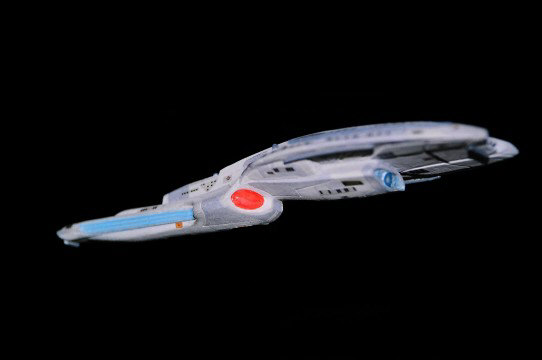

 Design by Ravenstar Studios,
model by Jason Abbadon
Design by Ravenstar Studios,
model by Jason Abbadon
Type: Light cruiser / cruiser
Length: 440m
Decks: 14
Crew complement: 245 (10 command officers)
Engine data: 2 integrated warp nacelles in one housing, 2 Hyper Impulse
engine systems. One warp core, one (inactive) reserve warp core.
Weapon systems: 9 Type-X phaser arrays covering all arcs. 5 dual purpose
torpedo launchers capable of firing quantum or photon torpedoes as well as
science and scout probes: 4 covering the forward arc and 1 covering the
aft arc.
Defensive systems: auto-modulating regenerative shielding and ablative
armor over key systems (torpedo magazines, launchers, bridge and impulse
engines).
Experimental systems: one prototype Emergency Security Hologram, one
Mark-IV EMH. Internal adjustable transporter inhibitors.
Number constructed: 8 completed (Lynch, Shran, Everest, Douglas, Vorga,
T'Lanna, Thornhill, Lincoln), 2 destroyed (T'Lanna and Thornhill at Chin'toka)
with 18 slated for construction within three years.
The Lynch class was originally designed as a light cruiser to patrol known Federation space and its borders from external incursions by threat forces that could be intercepted by a larger force of starships.
On Stardate 49475.26, the prototype USS Lynch was nearly destroyed when the ship responded to an attack on a Talarian freighter by Tholian raiders. The raiders surrounded the Lynch and managed to avoid the ship's limited weapons coverage as they fired at the Lynch from outside its weapons range as they coordinated their attack on the outgunned starship. The Lynch was successful in engaging the Tholians until the Talarian freighter could escape at warp. The Lynch was itself saved from destruction by the late arriving Defiant class USS Javelin. The raiders escaped with no losses and continued to prey on shipping and independent settlements in the area for the next eighteen months. The Tholian government declared the raids to be the acts of "renegades" and disavowed any knowledge of the raiders' whereabouts or motivations. Starfleet Intelligence learns of a Dominion proposal to the Tholian assembly to build shipyard facilities in Tholian space in exchange for control over neighboring star systems and technological upgrades to the Tholian fleet.
The Lynch herself was towed to Starbase 266 and computer records of their engagement were studied by the SCE and ASDB. The result was a year in drydock where two additional torpedo tubes were installed, the phasers were upgraded to the new type ten variant and three additional emitters added to cover gaps in the ship's aft weapon arcs. Ablative armor was added to key systems. The Lynch's command staff, under Captain Christopher Raven, elected to remain with the ship for the duration of the re-design and upgrades. On stardate 5042.4 the USS Lynch was re-designated as a "cruiser" and a new mission profile was undertaken for shakedown and additional testing purposes: escort and patrol duty in the known area of the raider's operations and along the Federation/ Tholian border alongside the USS Javelin and the Los Angeles class USS Miami. Pressures on Starfleet resources from the brief war with the Klingon Empire and the beginning of open warfare with the newly formed Dominion/Cardassian alliance left many outposts and shipping convoys vulnerable to attack by raiders, pirates and hostile governments with disputed claims on interstellar shipping routes as both starships and supplies were diverted to the front lines.
After five uneventful months patrolling the region and continued testing/refinement of experimental systems, the raids on shipping resumed and on stardate 48470 the Lynch and Miami a force of six Tholian raiders and -to their surprise- a Breen warship. The Lynch destroyed four Tholian raiders and the Miami critically damaged the Breen ship, causing it to retreat at warp. The retrieved remains of two damaged Tholian starships indicated the presence of Dominion polaron weaponry and several unknown components believed to be organic in origin. The Federation council condemned the use of Dominion technology by the supposedly non-aligned Tholians to destabilize federation supply lines and threatened military action if the raids continued. One week later, on Stardate 49475.2, the Tholians signed the Dominion's non-aggression treaty and stated they would offer no aid to either side during the war.
The Lynch was officially commissioned and starship production began at Utopia Planitia with the USS Douglas. The Douglas was still under construction at Utopia Planitia when the Breen attacked Starfleet headquarters on Earth and was one of twelve starships that intercepted the Breen force before critical damage could be inflicted on Earth and the UT shipyards. Lynch-class cruisers have proven themselves in several major battles of the Dominion War and are slated to go into widespread production as Starfleet begins fleet rebuilding in the post-war era.
| Home | ||
|
||
| Last modified: 06.03.18 |  |
|