

Starships F-H

|
Advanced
Starship Design Bureau Starships F-H |
||
|
|||
| Starships | Shuttles | Equipment | Technology | History | Other | New | Submit | |||

 Starships
Starships A-B, C-E, F-H, I-L,
M-N, O-Q, R-S,
T-Z,
Space Stations
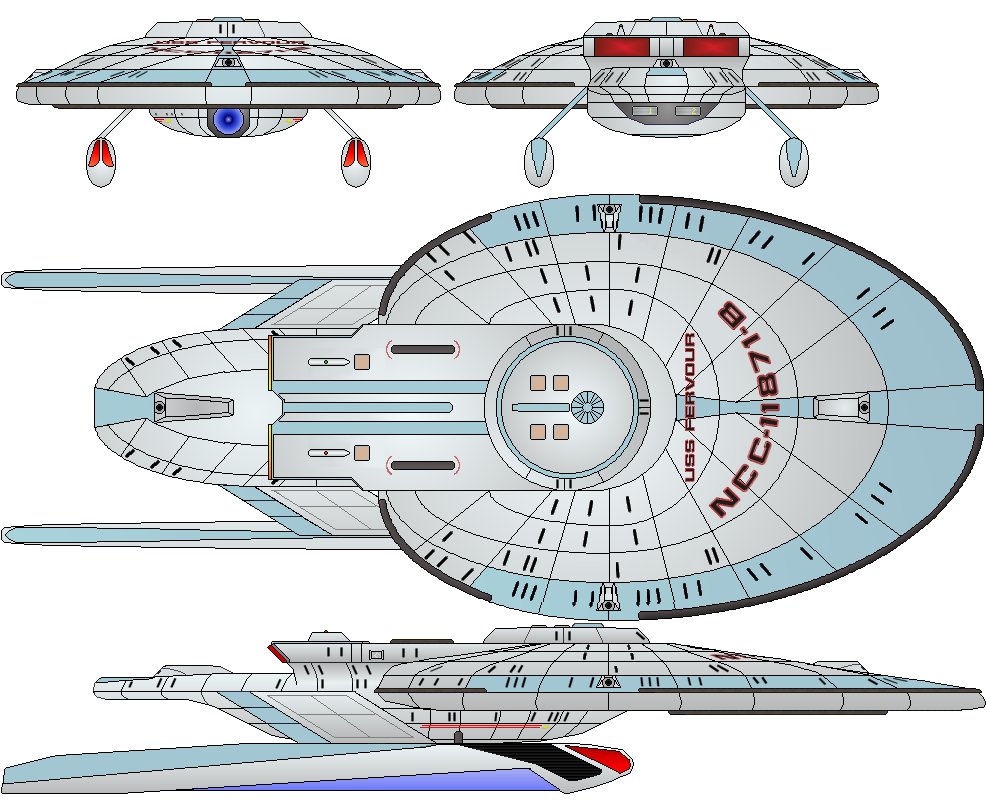
Fervour Class
 Design by xerent,
history by Paladin
Design by xerent,
history by Paladin
Type: Scout
Length: 200m
Decks: 8
Crew: 120
Weapons: 6 phaser arrays, 4 torpedo launchers (front, aft, port, stern), 50 quantum torpedoes
2 shuttle bays
With the threat of the Dominion and the Borg, Starfleet ships were forced to adopt a more combat-oriented role. Subsequently, developing designs were created with extra emphasis on advanced tactical systems.
In 2370, a Miranda-class replacement was proposed: the Fervour-class. At 200m long, this vessel would be useful where a Nova-class was unsuitable or underpowered and an Intrepid-class was unneeded.
The initial design proposal passed with few revisions. The ship harkens back to several predecessors: one cannot help but think of the Excelsior, with the saucer-mounted Impulse engines, nor the Nebula, with the tightly-packed, underslung fuselage. The nacelle configuration, very similar to the Miranda and Centaur, was picked for both aesthetic and technical reasons. It was determined that by placing the warp nacelles below the hull, warp field efficiency was improved, and thus, the final design change was made.
The vessel was also one of the first to incorporate bioneural gel packs and, later in the design process, Quantum torpedoes. These advanced technologies give the Fervour much more computing capability and firepower than any Starfleet vessel in its size range, save for the Defiant.
During the Dominion War, new Fervour-class vessels were fitted with ablative armor, although it is unknown whether this trend will continue after the war.
The first of the class, USS Fervour NCC-11871-B, was launched in early 2372. Extensive testing followed, and by mid 2373, the design was certified for full production. The ship was, however, overshadowed by others in the Dominion War, as shipyards increasingly switched production to even more combat-oriented vessels. Many of the class were cancelled in favor of Defiant-class vessels, but with the end of hostilities, the Fervour will have a bright future indeed.
Four-Nacelled Ship
 Design by Jason, ASDB Member
No specs available
No description
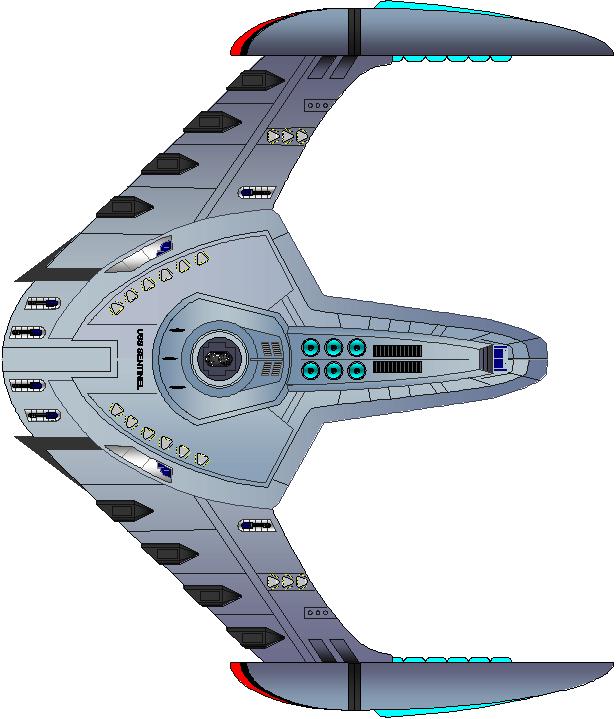
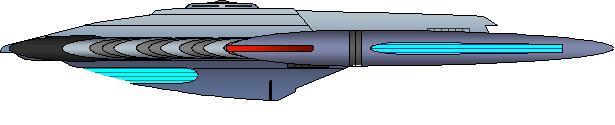
Frontiersman Class
 Design by richard rogers
Type: Attack cruiser
First commissioned: 2374
Length: 228m
Width: 230m
Height: 42m
Decks: 11
Displacement: 612000t
Complement: 40 officers + 124 crew, evacuation limit: 600
Speed: Warp 9.48 (cruise), Warp 9.89 (max.), Warp 9.96 (max. emergency)
Sublight speed: 0.8c (max.)
Armament: 8 pulse phaser canons, 2 torpedo launchers, 4 type-twelve phaser emitters
Embarked craft: 8 Avenger class fighters, 2 type-21 warp shuttles, 1 landing craft, one work bee
The Frontiersman class starship was a heavily armoured rapid-reaction vessel, initially designed and developed to counter the Dominion threat. Following the destruction of USS Odyssey and faced with the possibility of heavy losses during a Dominion invasion, Starfleet identified the requirement for a vessel with which to shore up Federation borders in addition to providing limited command and control facilities. Starfleet R&D engineers based their initial designs on the earlier Defiant Class escort ship which, despite its initial failings, had proved to be an extremely capable warship. However, when the pathfinder vessel, USS Frontiersman (NX-94311) was launched in 2372 it suffered from the same design flaws which had blighted the Defiant and the ASDB considered abandoning the project. Major redesign was carried out during 2372-73, including modification of the basic space-frame. Indeed, such was the extent of the changes, that the ship was re-registered NX-94311-A. This redesign also saw the incorporation of the Avenger class endo/exo fighters, replacing the Hunter fighters which had been part of the original design.
The modified Frontiersman was launched in 2373 to conduct operational evaluation studies. During four months of extensive flight trials, it became apparent to the ASDB that their hard work had paid off, the Frontiersman finally realising the capability it had long promised. Starfleet approved the initial production of a further seven vessels to be rushed into service to supplement the rapidly depleting Fleet, whilst USS Frontiersman was to be upgraded to production standard. The first production variants of the Frontiersman entered service in 2374, and were used to good effect during the latter stages of the Dominion War. Notable among these were USS Beowulf which single-handedly destroyed seven Dominion and Breen warships during the battle of Cardassia and USS Regensburg which was crewed my former members of the Marquis resistance movement who had petitioned the Federation to allow them to join the fight. The Regensburg used the Badlands as its base of operations of which the crew had extensive knowledge. They resumed “terrorist” operations, conducting missions deep behind enemy lines with devastating results. With the war over, the Quadrant faced a turbulent time with both the Cardassian Union and Romulan Empire in disarray. Several minor powers came to prominence during this time, posing a threat to the peace and stability.
When the Amon’hari war erupted in 2391, the Frontiersman vessels in service proved to one of the more successful warships in the fleet. In 2395, a squadron of vessels under the command of Admiral Aguri Chen led a major counter-offensive against Amon’hari warships which was to be a pivotal moment in the war. During the early part of the 25th Century, the Federation turned its attention to the Cardassian Union which had dissolved into anarchy as several rival factions fought to gain control. In 2411, the USS Trajan was dispatched to resolve a dispute between the Suuhk and the Valq’hesh, two of the major factions. Such was the fearsome reputation of the Frontiersman Class, that its mere presence was enough alone to prevent a bitter feud breaking out into conflict. Unfortunately, the Suuhk and Valq’hesh, fearing a Starfleet invasion following the Plenori Incident of 2416, were to form an alliance against the Federation. Once again, Frontiersman vessels found themselves on the front line fighting in a viscous border war which was to last 8 years. In 2424, in a bid to prevent further casualties, the Federation agreed to withdraw its forces and establish a Neutral Zone along the border. However, a handful of Frontiersman vessels were left behind to patrol the border and were eventually withdrawn from active service in 2433.
Furious Class
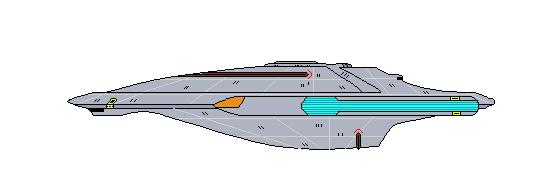 Design by Mikey
Type: Heavy escort
Ships in service: 16 in service, 6 under construction, 35 authorized,
hundreds planned
Length: 208m
Beam: 46m
Height: 17m
Speed: Warp 7.5 (cruising), Warp 9.55 (max.), warp 9.99 (emergency)
Crew: 13 officers, 46 NCO
Weapons: 5 Type-IX phaser strips, 2 Type-3 burst fire torpedo launchers
(turreted, aft) with 45 torpedoes each
Embarked craft: 1 Type-11 shuttle, 2 Type-10 shuttles, 4 Type-18 shuttlepod
Ganymede Class
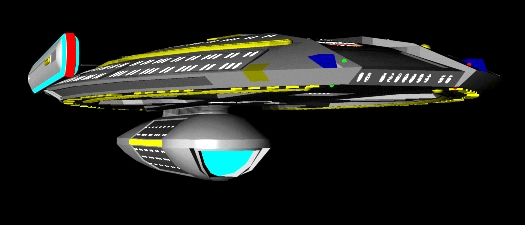
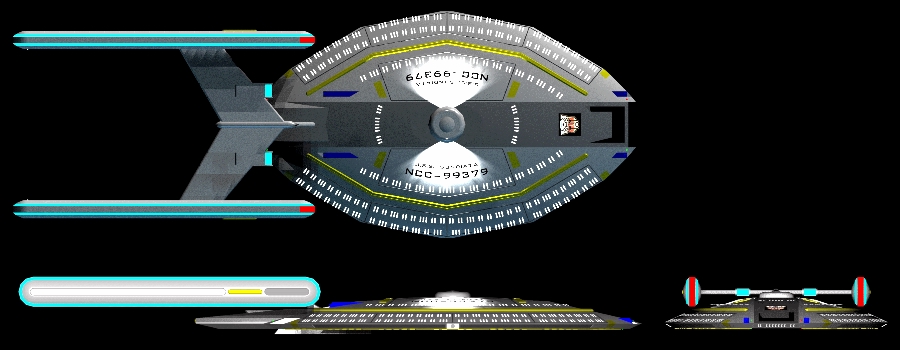
 Design by Robert
Heckadon
Design by Robert
Heckadon
Type: Multi-role cruiser
Length: 415m
Width: 150m
Height: 38m (without module)
7 Decks
Speed: Warp 9.8 for 12 hours without additional nacelles and warp reactors. Warp 9.95 for 2 hours, same conditions.
Weapons: 8 Type-12 phasers, standard; 4 photon/quantum torpedo launchers,
standard
Crew complement: 150 officers and crew, standard
The design concept of this new starship is similar to an early concept of the abandoned Nova Class Explorer. It has a connection port for a modular secondary hull that can be replaced in less than an hour with a different mission specific module for a wide range of missions. Most of the missions it is on does not need a secondary hull so the ship can operate totally independent of the secondary hull. The ship also has a "Face Plate" for more immediate identification of the mission of Ganymede.
Gladiator Class
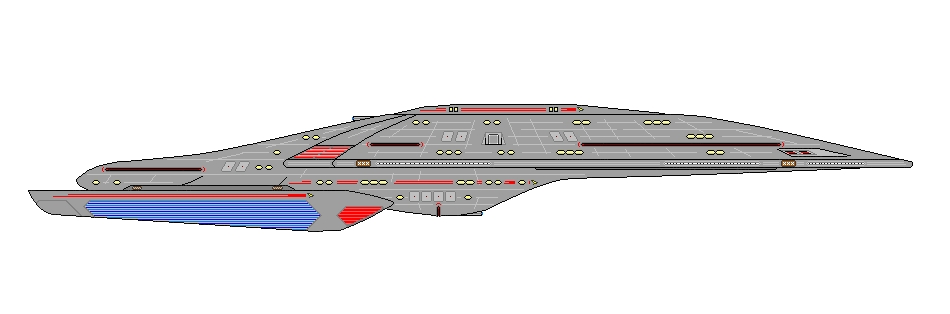 Design by Novice
Type: Escort
Commissioned: 2381
Length: 209m
Height: 33m
Width: approx. 75 meters
Decks: 8
Crew: 100
Normal cruise: Warp Factor 8
Maximum cruise: Warp Factor 9.9
Maximum rated: Warp Factor 9.99 for thirty-six hours
Armament: 11 x Type-X phaser arrays, 4 x Type-I pulse phaser
cannons, 4 x Burst Fire Quantum Torpedo Tubes + 200 torpedoes
Defensive systems: High Capacity Auto Modulating Regenerative Shield System,
20cm Ablative Armour
No description
H Class
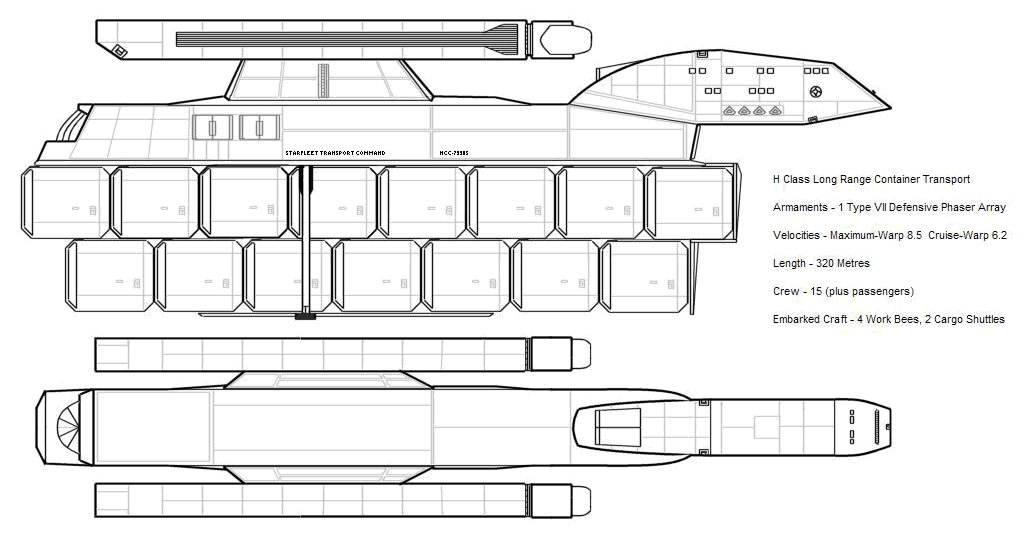 Design by Nathan Fortner
Type: Long range container transport
Length: 320m
Crew complement: 15 (plus passengers)
Speed: Warp 6.2 (cruise); Warp 8.5 (max.)
The H-Class was conceived to fill the need for a long range container and supply transport. The ship is a very versatile transport. The external storage of containers are held with tractor fields. The internal shuttlebay runs 3/4 of the way through the secondary hull and is used as internal storage for loose goods and supplies and can be used for transporting people with internal refits. The crew quarters and most systems are located into the smaller upper primary hull. The ship's lone defenses are a single phaser strip located at the front of the primary hull and is mainly used for navigation purposes.
Hammerhead Class
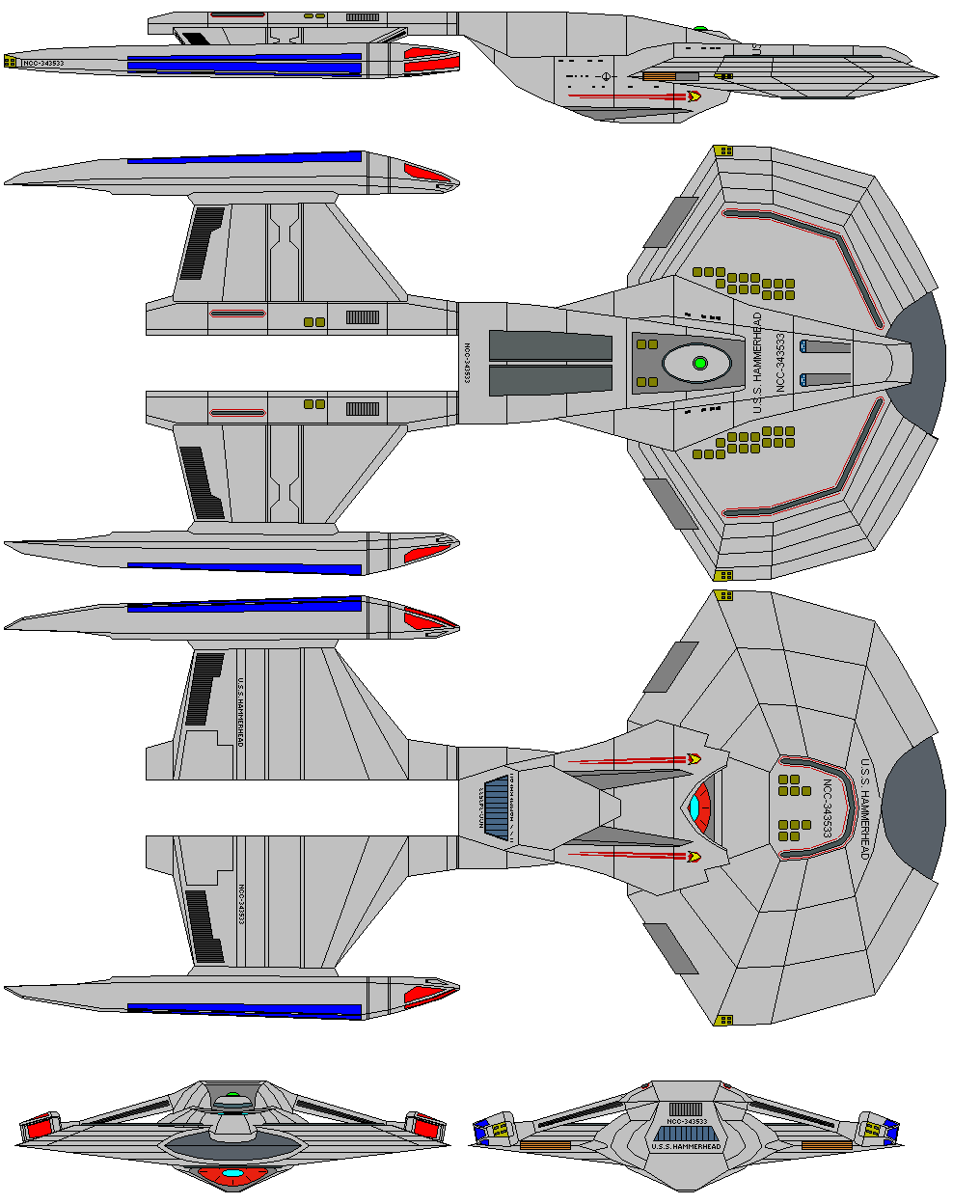 Design by Mackie
No specs available
No description
Hannibal Class
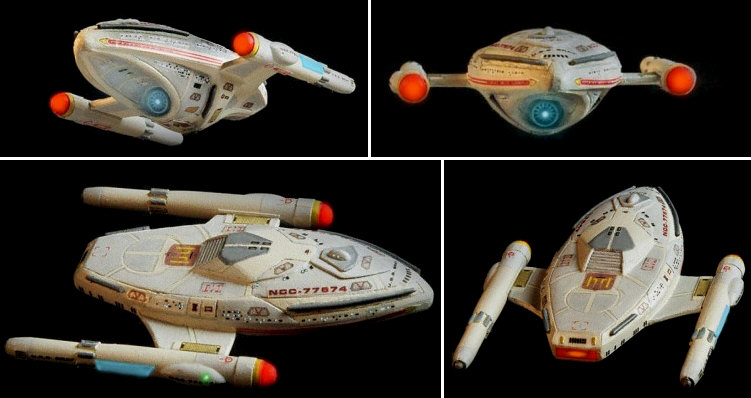 Design
by Ravenstar Studios, model by
Jason Abbadon
Design
by Ravenstar Studios, model by
Jason Abbadon
Type: Multirole vessel
Length: 247m
Width: 215m
Crew complement: 216 (9 command officers)
Engines: 2 warp nacelles, 1 impulse engine system, one warp core, one reserve
warp core
Weapon systems data: six Type-X phaser arrays covering all arcs, three photon torpedo launchers capable of rapid fire bursts covering all arcs as well as science probe launch
capability
Embarked craft: Three Type-10 shuttles, four Type-9 shuttles, three Type-18 shuttles, six
workbees
Number constructed: sixteen total with seven additional slated for construction within ten years. (Nine in hospital, four in
cartography/ mapping, two in science specialty and one in mobile tactical command post respectively)
The Hannibal class USS Bray is a new design intended as a multirole vessel with internal modular components allowing for easy equipment upgrade or conversion to science, tactical, hospital and stellar cartography suites. Equipped with a large main shuttlebay and two secondary shuttle landing/retrieval pads the Bray is ideal for scientific missions and limited exploration.
Harrier Class
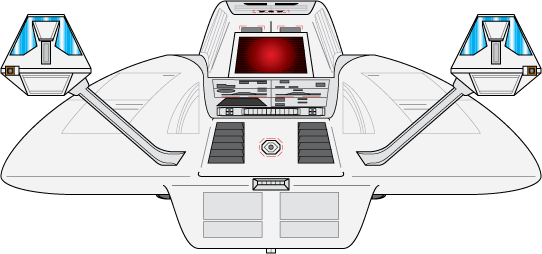
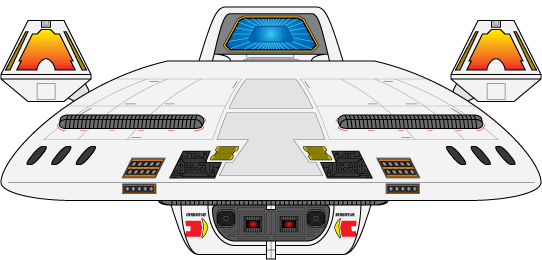

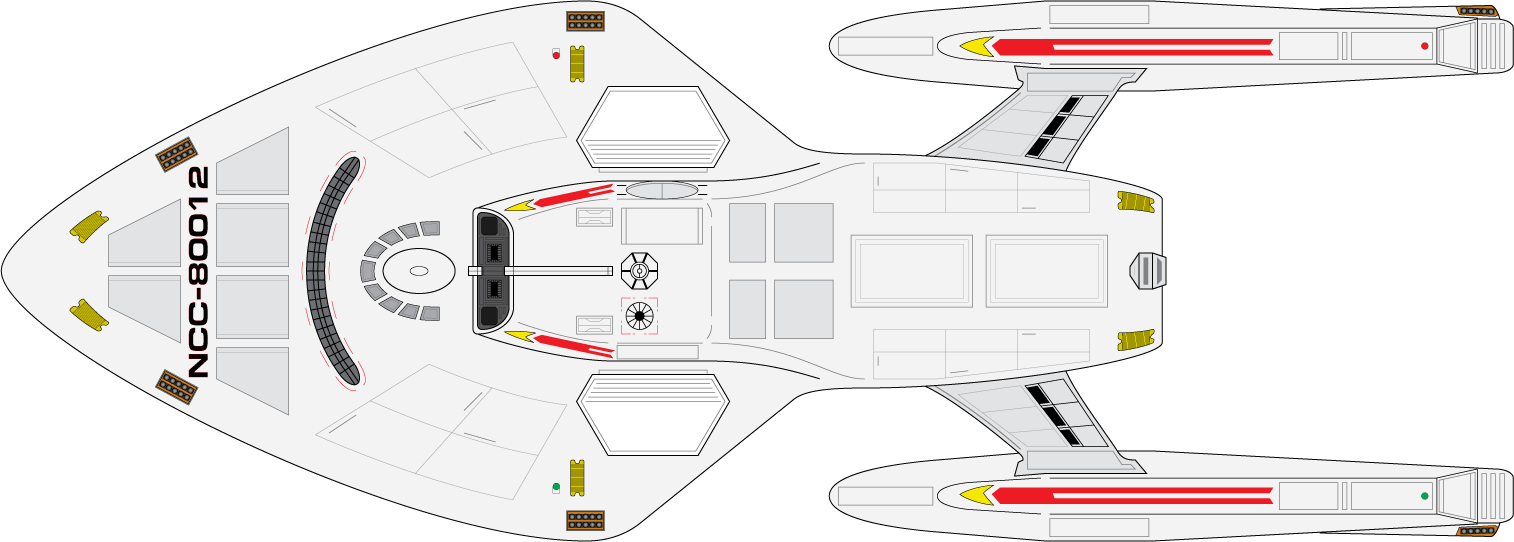
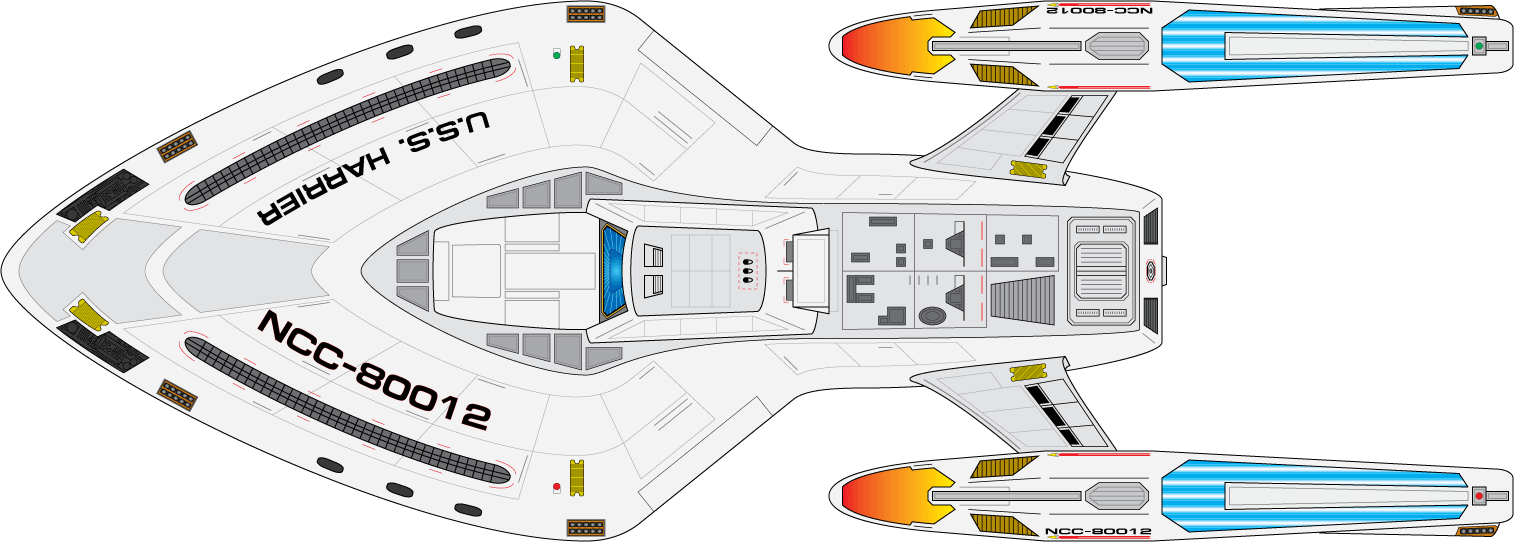 Design by Greg MacDonald & Broken Subspace Scene
Type: Tactical scout/light escort
First commissioned: 2378
Length: 84m
Width: 30m
Height: 14m
Decks: 4
Complement: 22
Speed: Warp 5.2 (cruise), Warp 6.5 (max.), Warp 9.8 (max. emergency)
Armament: 2x Mark I pulse phaser emitters, 2x Standard c2372 pulse fire torpedo launchers: quantum/photon payload certified, 3x Type-VIII phaser arrays, 1x Type-VII phaser emitter (aft)
Propulsion systems: 1x Solo I-87 impulse drive & manifold: Nova-class standard, 2x
Remiges-I warp nacelles, 1x SLC II warp core, 8x RCS thrusters
Embarked craft: none
Registration:
Starfleet Model No: K-44
Mission Roles: First responder, light escort, secure courier, patrol cutter, limited
duration surveyor active duty
Vessels: NX -80012 (prototype, pending full commissioned status), reserved serial No.: 80045-80145 (tentative reservation; pending successful testing)
Reserved names (first run): Skua, Umidori, Kite, Warbler, Merlin, Sparrow, Hiyō, Goshawk, Sunbird, Kingfisher
Proposed: 2375
Approval – Starfleet Appropriations Board: 2376
Prototype completion: 2377; currently conducting six-month shakedown cruise
Commissioned: 2378, subsequent to adequate performance of prototype unit. Planned Flight I run of 100 vessels, reassessment for possible construction of Flight II will take place in 2380.
“My friends, what we need are hulls.” - Rear Admiral Oleg Kovalev, in his 2375 address to the Federation Security Council
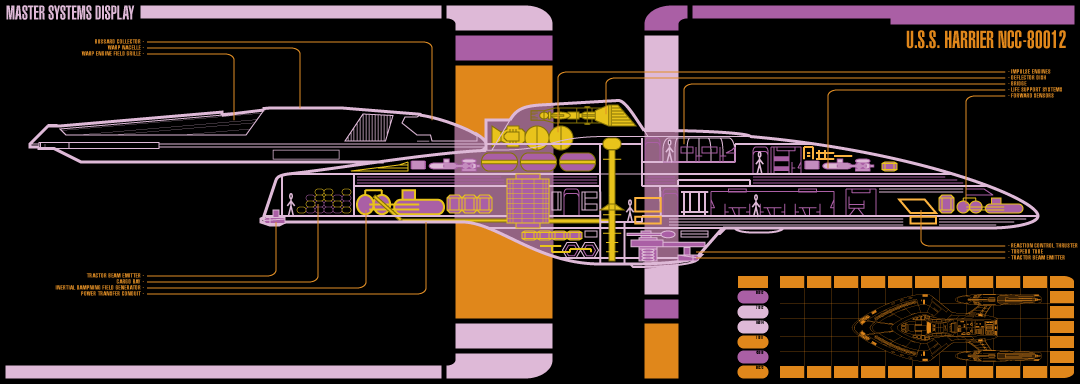
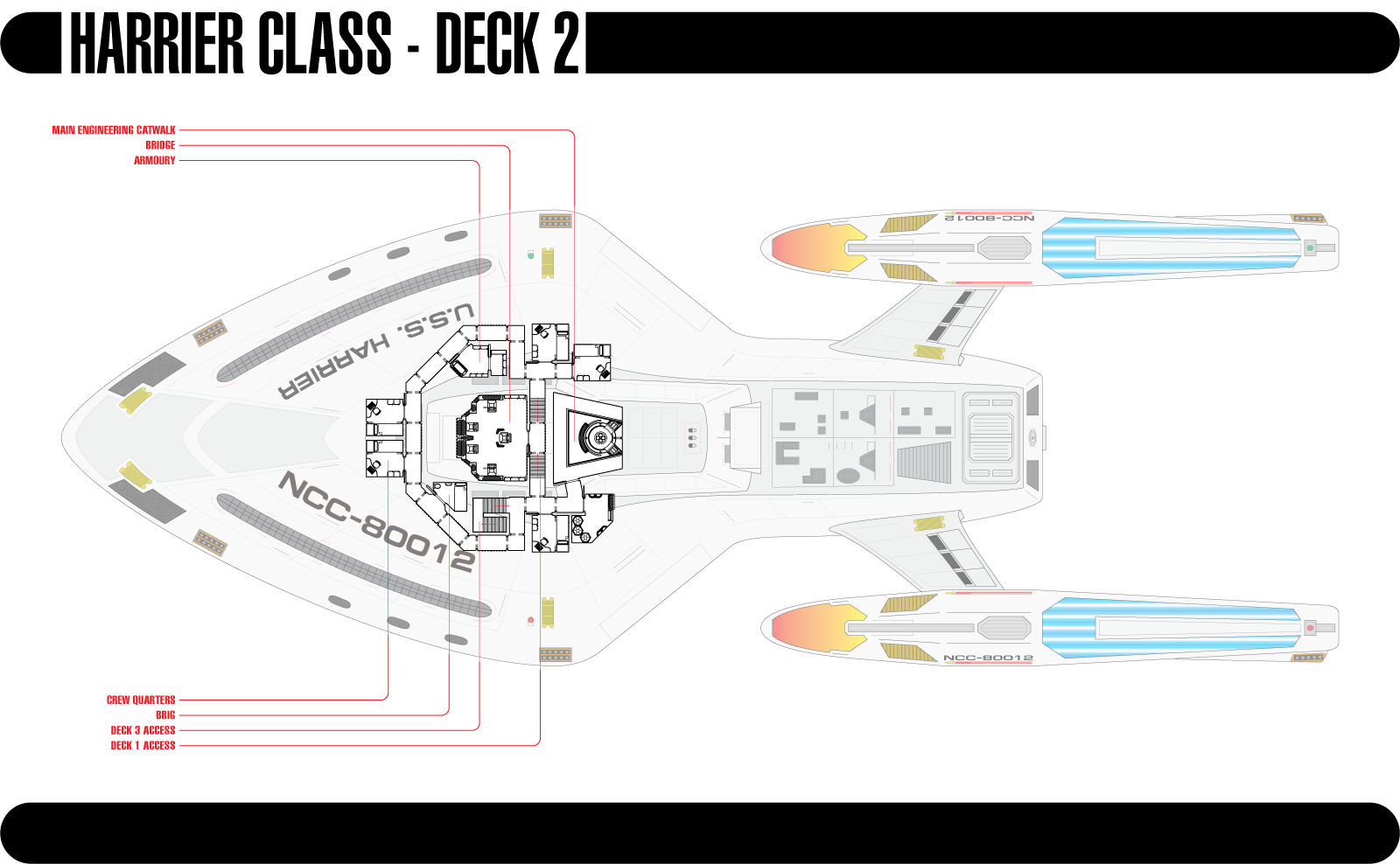
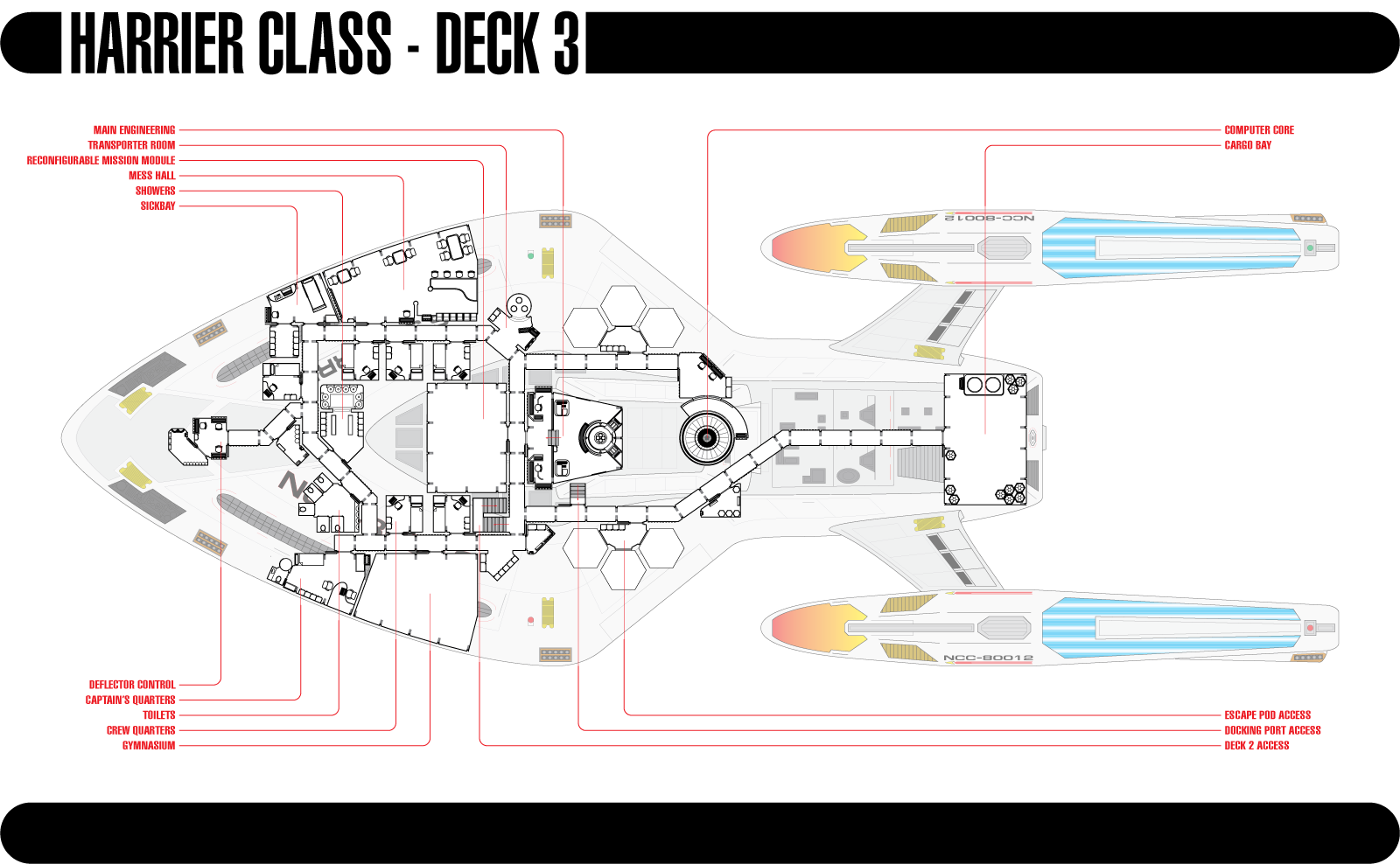 The Harrier-class tactical scout is one of numerous starships to leap off the ASDB design tablets in the late stages of the Dominion War. It is intended to fill the longstanding gap in capability between the fleet’s Runabouts and the first size tier of starships: the Oberth-, Nova-, and Defiant-classes.
The original design proposal cited a deficiency in the overall number of active starships in the fleet during the war: numerical superiority was difficult to achieve, and the heavily customized nature of Defiant-class components did not lend themselves well to construction on the scale of Jem’Hadar attack craft or Klingon Birds of Prey. Furthermore, many of the fleet’s vessels simply did not have an adequate response times to counter threats such as Borg or Dominion incursions. The Harrier was designed to provide equivalent firepower to these alien craft in a similar size range. Eschewing the emphasis of many small craft on endurance, it is capable of achieving extremely high speeds – a maximum of warp 9.8, faster than the Defiant-class – for limited periods of time. Otherwise, the compact nature of the class dictates extremely mundane levels of performance.
Aside from patrol and combat duties, the Harrier is well-suited for missions when a Runabout is simply not adequate but, conversely, a major starship is not required. Its high warp speed makes it ideal for quickly assessing phenomena when larger vessels are not available; a scaled down full-spectrum sensor suite from the Nova-class provides suitable sensor functionality. It is also superior to Runabouts for the transport of high value personnel or cargo, and provides an excellent light escort for transports and convoys.
“It’s different...but I think I like it. How fast does she go?” - Dr. Rasheeda Williams, New Systems Evaluator, Copernicus Shipyards
Unlike the Defiant-class configuration, in which nacelles are tucked into the ship’s main body and heavily armored, the Harrier’s nacelles are conventionally mounted on nacelle struts. It was determined that this placement was simply more efficient, not to mention far ‘cheaper’; proven warp dynamics could be used, without the Defiant’s complicated equipment and adjustments. The design, which can still be considered unorthodox, features a unique deflector dish placement and a sleek, aerodynamic hull form that contrasts sharply with recent ‘unibody’ small craft designs. To achieve the high warp speeds mandated by its mission, a lower-profile deflector dish like those employed on the Defiant-class or even Runabouts would not be suitable. Furthermore, a secondary deflector was prohibitively cost- and space-consuming. As a compromise, the deflector is mounted above the saucer, on the dorsal hull. While this prominent placement means the Harrier is more vulnerable in combat, its small size means a strike to virtually anywhere on the hull will cause extensive damage. The Impulse engine is situated in a unique position in the same frame section as the deflector, which allows the entire section to be manufactured separately and integrated into the design en masse.
“She flies and she fights. This is a Bird of Prey by any other name.” - Captain Aldrishyan, after completing the ship’s first combined systems test
The Harrier is one of the few ships in Starfleet’s inventory capable of atmospheric travel. While landing gear is absent, the ship is designed to easily land in docking cradles and can be constructed entirely in a terrestrial environment. Performance in deep space is impressive: the ship is capable of extremely fast sublight speeds, and maneuverability is ample, despite the ship lacking the inherent balance of an integrated hull form. The ship’s impressive warp speeds come at the expense of limited endurance and high maintenance. Like the Defiant, its larger, elder sibling, the Harrier essentially guzzles fuel, and requires relatively frequent deuterium top-ups. The warp nacelles also have a significantly shorter operating lifetime and more far more demanding maintenance schedule than larger starships. For these reasons, combined with its limited amenities, Harrier-class starships are expected to typically have dedicated Starbase homeports. Alternatively, they may lean on larger parent craft, such as Galaxy-class starships, for ongoing refueling and replenishment. Missions will likely last 1-3 weeks of continuous duty.
The saucer contains entirety of the ship’s broad-coverage weaponry, with two Type-VIII phaser arrays mounted on the dorsal surface, and another, shorter array on the ventral side. A single Type-VII emitter at the extreme aft tip of the ship provides a modicum of protection. The Harrier’s main firepower lies in the pair of pulse phaser cannons built into the lower hull protrusion, as well as a pair of dual payload torpedo launchers. The pulse phasers and torpedo launchers fit into a semi-modular assembly area, allowing easy replacement and upgrading. Overall, the armament is significantly less than most capital ships, but vastly superior to any similarly sized Starfleet vessel. Defensive systems are adequate but unremarkable: deflector shielding is moderate and lacking in significant redundancy, and the use of ablative armor was rejected out of concern for cost effectiveness. Nonetheless, a Harrier is capable of fighting any of its benchmark competitors to a standstill, if not emerging victorious.
“A most efficient use of resources.” - Commander Falvek, ASDB, in his address to the Starfleet Appropriations Board
To suit the needs of mass production, the Harrier uses “off the shelf” components to a degree never before seen. As a result, the Harrier is easily the “cheapest” full-fledged starship to construct on a capability-to-cost basis. Its Impulse drive and manifold are lifted wholesale from the Nova-class (in a single, rather than twin arrangement), while the SLC II warp core is an amalgamation of parts from the Defiant and Impala-class surveyor designed to meet Harrier’s relatively intense power requirements. The three phaser arrays are based on the second generation Type-VIII arrays used on the latest Norway-class vessels, while the dual payload launchers are mundane units used in a variety of starship classes. Similarly, the two pulse phaser cannons are mostly indistinguishable to those used on the Defiant. Some components of the ship are overpowered or scaled up versions of those found on the latest small Starfleet designs; the Danube-class Runabout and Venture-class scout, most notably. Many of the remaining systems are comprised of the small, reduced capability backup or redundant systems from larger starships. One of the few unique systems on the prototype craft—and its most controversial—is a cloaking device port, locating under a nondescript floor panel in main engineering. Based on the post-Dominion War climate—particular the thaw in Federation-Romulan relations—it was considered a prescient design feature. If the treaty of Algeron is rescinded, the Harrier will be essentially ready-made to accept either a discreetly designed Starfleet cloaking device (based on the Defiant crew’s extensive studies) or a modified Klingon Bird of Prey cloak. Should a cloak become politically feasible, it is likely that the Harrier will essentially become a Starfleet Bird of Prey. It is unknown whether this particular system will be included in production versions of the ship. Even without the use of a cloak, the Harrier is somewhat adequate as a prowler craft.
The Harrier carries no auxiliary craft. The hull itself is packed densely with machinery in an arrangement more reminiscent of a shuttlecraft than a capital ship, and the relatively small size of the craft itself led to a shuttlebay quickly being deemed unnecessary. The Harrier does have several mounting brackets on her hull which can be used to transport shuttlecraft. Six escape pods provide adequate evacuation capacity.
A crew of only 22—three shifts of seven to eight personnel—makes up a full Harrier-class complement. The four-person alpha shift bridge crew consists of a commanding officer and Tactical, Helm, and Operations stations, but typically a crew of only two operates the bridge. At least one crewman is typically assigned to maintenance duty, with three based in Main Engineering. In an emergency situation, a crew of four can effectively operate the vessel. The bridge itself—which protrudes only slightly out of the hull—is merely an enlarged and retooled Runabout cockpit, with the conventional layout modified to include a captain’s chair.
Considering the immediate demand of starships in the wake of the Dominion War, the approval process for the Harrier has proceeded with impressive speed. The NX-80012 herself is currently being tested, and has met or exceeded expectations thus far. This would not have been possible without the successful taming and implementation of the Defiant-class over the preceding several years. It is expected that a single Harrier will take an astonishingly small period—four and a half months—to complete. If the prototype passes space trials, it is likely the first series of craft will begin construction immediately to supplement the current demand for patrol craft around sensitive worlds and Cardassian border space. Planning has been made for the first Flight to be produced in four simultaneous waves of twenty five units each, with principal production taking place in the Antares and Copernicus shipyards. If a future order is placed, production may be switched to ground-based, retooled Runabout construction facilities.
Interior
“Well, picture the Defiant.” -
“Ok, that’s not too bad for a small ship...” - “--but worse.” - Provisional Captain Jakub Hossa describing Harrier’s interior to new XO Janice Mendhi
Bridge: The bridge module is a slightly enlarged version of a Danube-class Runabout cockpit, which includes two viewports and integrated holoprojectors. As in a Runabout, the Conn and Ops stations are positioned directly below the windows and occupy the entirety of the forward section. A tactical station is positioned on along the starboard bulkhead adjacent to the captain, with a predominantly unused Science/Auxiliary station on the opposite side. The bridge is spartan in comparison to larger craft and is almost identical to a Danube-class Runabout in aesthetics and trimmings.
Main engineering: Main Engineering, in a contrast to recent Starfleet designs, is a fairly cramped space. The room resembles a squared-off triangle, with the warp core located at the narrow end. Recessed anti/antimatter injector piping similar to the Defiant-class connect with the core at 45^ angles. Large L-shaped workstations fit into the other two corners, while a smaller reactor control console sits at the immediate base of the core, in front of the spherical intermix chamber. The core is slightly recessed into the decking, and the Engineering room itself is a single, slightly oversized deck. The ceiling slopes sharply towards the core itself. The room contains three Jeffries tube access hatches, and is unique in containing many quick access panels and pieces of exposed machinery visible in the bulkheads. As per c2363 Starfleet guidelines, the warp core is capable of ejecting. However, Engineering lacks failsafe forcefields and inner security doors. In the event of an ejection or containment breach, the entire room must be sealed and evacuated. Deflector Control room features many features of an auxiliary engineering site.
Ready room: The Harrier lacks a proper ready room. The captain’s quarters are in close proximity to the bridge and feature a desk and computer terminal.
Mess hall: The ship’s mess hall features a small kitchenette in a bar arrangement, as well as a single Series V food replicator. Three tables seat a total of eight. Several stools run along the kitchenette’s serving counter. The Mess Hall is also used as a source of entertainment, and features a small holoprojector along one bulkhead. The overall layout and aesthetic resembles a smaller version of the Intrepid-class mess hall.
Conference room: A small conference room includes a viewscreen and lozenge-shaped, six-person table.
Sickbay: Sickbay is significantly limited, even in comparison to other small starships. There is one permanent biobed (with available isolation field), and the ship’s medic has a pair of office stations. Sickbay is mainly used to treat combat trauma and common ailments, and consequently lacks the more sophisticated research and diagnostic equipment of a larger facility. It is also limited in staff; only one medic is available (typically a biologist with secondary training). However, after many Starfleet appropriations board members questioned the idea sending a nominally combat ship into action without a doctor, the sickbay was redesigned to include a Mk. III Emergency Medical Hologram. The holoprojection technology necessitated the removal of the originally planned second biobed.
Transporter room: The transporter room and equipment is a near direct transplant from the Defiant class, albeit modified to fit in an even smaller space. The transporter pad can accommodate only three individuals at once, making it less than ideal for away teams. There is no secondary transporter, save for a small cargo unit in the cargo bay. Overall, the lack of significant redundancy (compounded by a lack of auxiliary craft) renders the Harrier inadvisable for medium- or large-sized away team missions, especially in hostile scenarios.
Reconfigurable Mission Module: The RMM is a reconfigurable space designed to imbue the Harrier design with some degree of versatility. The room is equipped with a number of power and data lines allowing equipment to be integrated relatively seamlessly with ship’s systems. The default configuration is a small science lab (which the Harrier otherwise lacks), with other prominent configurations including VIP quarters for high-value personnel transport, a crew lounge, and an auxiliary cargo hold. Less common configurations include additional personnel quarters, heavy weapons locker, microfactory/replication facility, and tactical planning suite.
Brig: The brig is a small, enclosed space bordering a corridor, rather than a full room. It features a bunkbed, exposed lavatory, and small washbasin. The interior paneling is completely sealed and there are no accessible control panels or power conduits. Given the vulnerability of the Harrier to systems failures in a combat situation, the brig is secured with a series of sliding transparent aluminum bars, to ensure prisoners remain secure even in the event of a catastrophic power failure.
Armory: The Harrier’s Main Armory incorporates a number of improvements included in latest ships of the line. Access codes and biometric verification systems greatly reduce ease of access for unauthorized personnel. The system’s biosensor links with the central computer’s strategic understanding database, as well as the ship’s standard security logs. As a result, current adversaries or conflicting parties, such as
Jem'Hadar or Cardassians, will be by default locked out of the armory, unless they constitute recognized personnel. Brig prisoners are likewise barred access.
Typical stores in the main locker include small numbers of Type-IIID phaser rifles and Mk.1 compression phaser rifles, along with numerous Type-II hand phasers. A double-secured sub-locker contains a limited quantities of charges and photon grenades. Approximately four secondary weapons lockers are located in strategic areas, with each holding a handful of hand phasers and, in the case of the Main Engineering and Bridge lockers, a phaser rifle.
Captain’s quarters: Captain’s quarters feature a reasonable sized bed, desk terminal and guest chair, which function as a makeshift ready room, and a 3-piece ensuite bathroom. A personal replicator is also included.
Quarters: Quarters are nearly identical to Defiant-class specifications. Each unit features two beds, a small desk and computer terminal, and UTIL-9 personal replicator unit. Ergonomic gel beds are positioned in a stack arrangement, and each features a privacy curtain and low-level sound deadening field.
Gym: Given the dearth of living space and amenities, the gym is used for disproportionately large periods of time by Harrier crews. It fills the space of approximately 2 crew quarters. Equipment includes two treadmills; a weight set; a cushioned floor area for meditation, Suus Mahna, yoga, and more; limited actuation mechanical combat dummy; and a small beverage replicator.
Personal facilities: Given the cramped nature of ship’s living space, adjoining washrooms were an impractical solution for crew needs. Aside from small heads located near workspaces, several lavatories are located in residential spaces, with a ratio of approximately one lavatory per four crewmembers. There is a single communal shower room with appropriate arrangements for up to 8 personnel (an entire standard duty shift). A small, private adjoining room is available for species with unique or private bathing needs. Crew have the option of using sonic shower settings or sanitary gel.
USS Hauck
 Design by Kris, ASDB
Member
Design by Kris, ASDB
Member
Type: Engineering support vessel
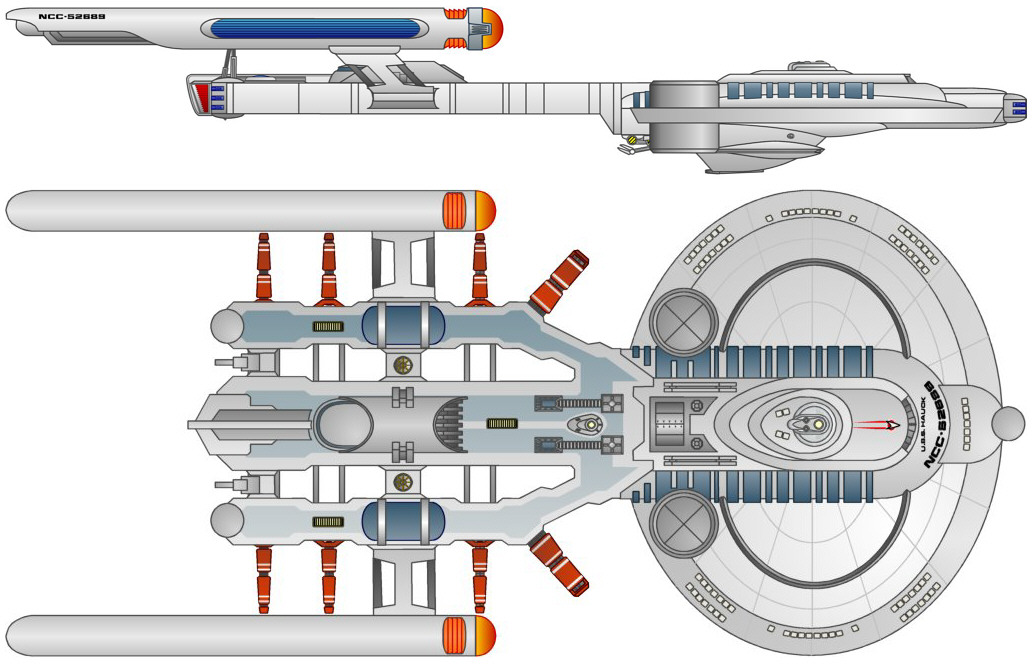
The USS Hauck was mentioned in Rick Sternbach's article about the Intrepid class development in Star Trek: The Magazine. From the description, it could be any type of starship, but an engineering support vessel would fit nicely.
Hayden Class
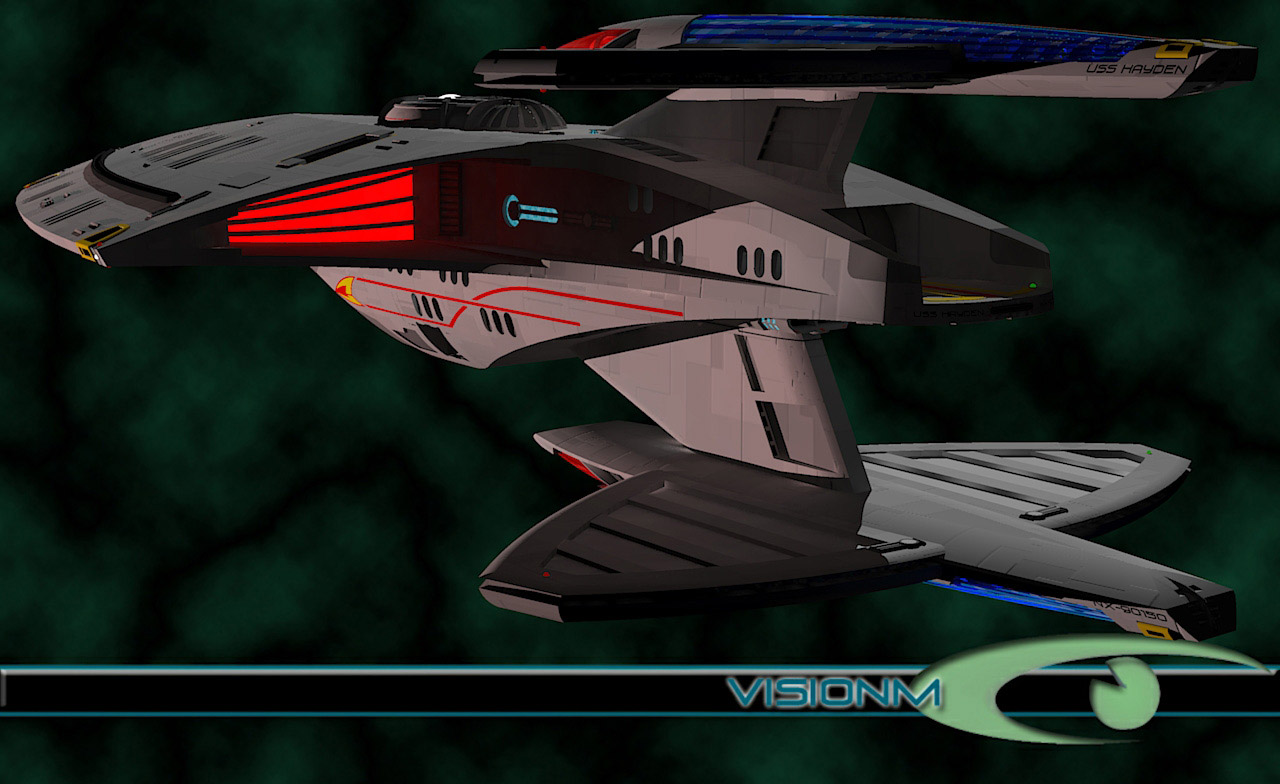
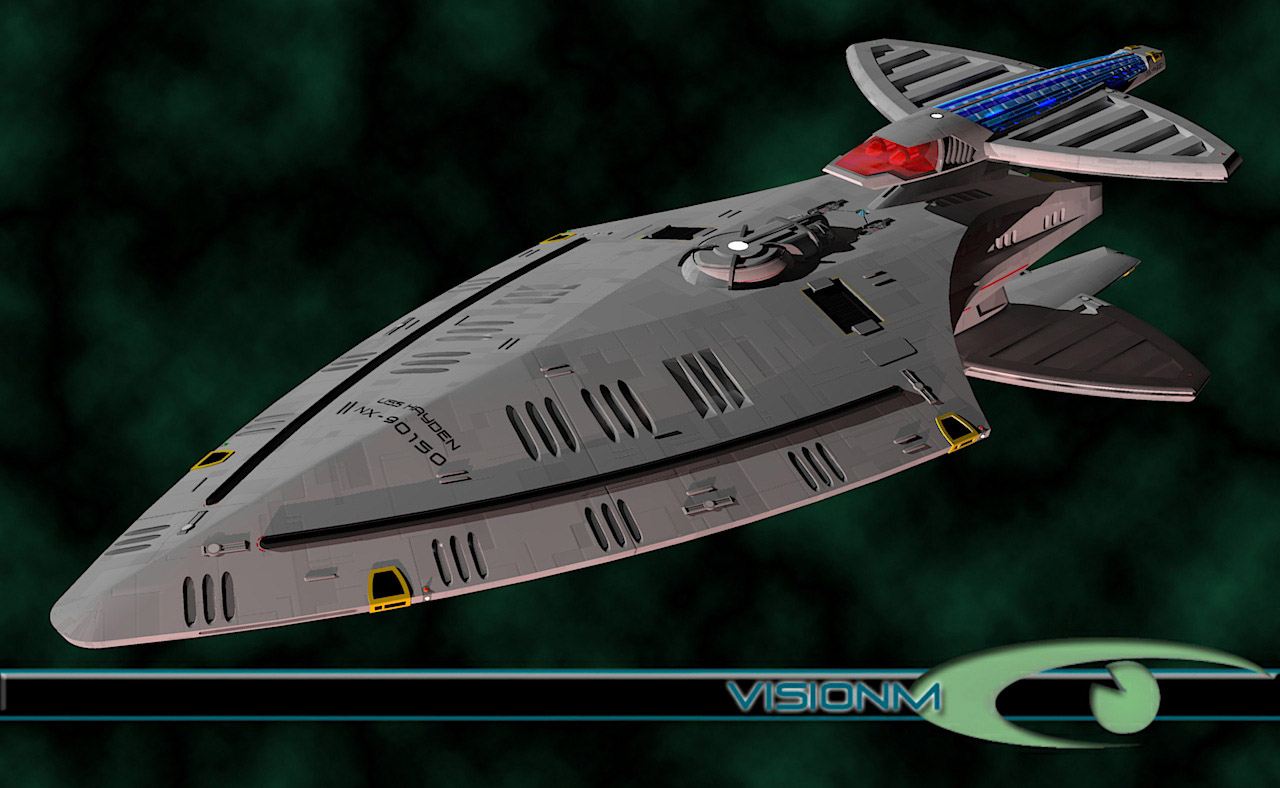 Design by Michael Bosscha aka BorgMan
Type: Scout
First commissioned: 2385
Length: 131m
Width: 54m
Height: 29m
Decks: 6
Displacement: 250,000t
Complement: 10 officers + 15 crew, evacuation limit: 52
Speed: Warp 8.2 (cruise), Warp 9.92 (max.), Warp 9.995 (max. emergency)
Sublight speed: 0.9c (max.)
Armament: Type IX phaser strips (5); Transphasic torpedo launcher (1 x 2); quantum torpedo launcher (1 x 2)
Defense: Standard shield system, total capacity 500,000 terajoules; Mark II ablative armor system, 3 centimeters; Standard duranium/tritanium single hull; Standard level structural integrity
field.
Embarked craft: Workbee (2); Type 12 shuttle (1); Captain's Yacht (1)
Ships in class USS Hayden NX-90150; USS Eisenga NCC-90151 (undergoing final tests); USS Adler NCC-90152 (under construction) USS Macmillan NCC-90153 (under construction); USS Campanus (planned); USS Walker (planned)
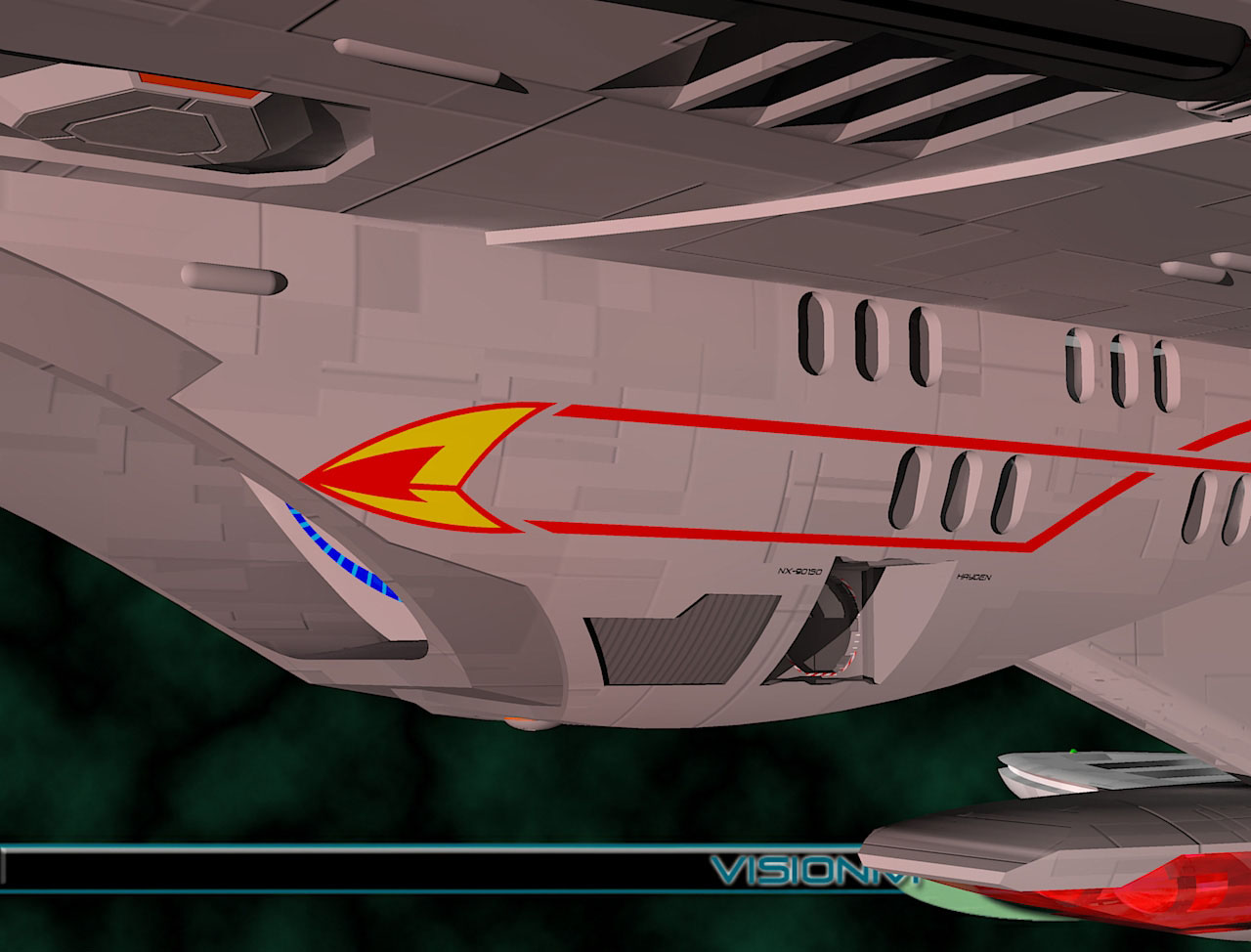
Mission statement The Haydens, under the direct supervision of SC², usually venture off of known shipping lanes, tend to avoid making first contacts as much as possible (leaving that sort diplomatic tasks to a ship of the line), and are fast. Their sensor-packed pods are directly connected to the nacelles and as a result feed off of them, making them very powerful. The ships are not unarmed but if they ever find themselves in a fight their main rescue is their sheer speed. They are slightly faster than an Intrepid class, but use a Defiance line core to gain that speed, which also brings some of its negative aspects with it. The pods also create a considerable subspace drag but Starfleet Command found the design elegant and small enough to justify this.
Outside of the shipping lanes things can get a little rough, though, especially when there are people operating there who don't want others to know what they're up to, like the Orion Syndicate. To counter that threat, Haydens have the latest ablative armor generators installed, deploying a 3cm thick shell when needed; this has helped in more than one occasion to get a Hayden out of trouble and back to the relative safety of a space station or friendly territory. Data collection is the most important task these ships have and they intend to return that precious data back to the Federation; they return to a data station, where they transfer off the collected data and where it gets transmitted using a highly encrypted subspace link. The ships themselves don't have the capability to send such a message as it would make them even more valuable for enemies of the Federation than they already are...
It is rumored that Section 31 uses an adapted version of the Hayden, complete with a cloaking device, but this hasn't been confirmed. During a crossover to an alternative universe it was discovered that this version of the Terran Empire used an almost similar design with a similar name; however, it was used for spying on the subjects of the Empire instead of the nobler cause our own Hayden supports.
Technologies
The Hayden class relies on its incredible speed to enhance its survivability in threat encounters. Several technologies were blended together for the first time in a production package that allowed hyper-impulse-like speeds without the complex equipment requirements of the traditional Hyper Impulse package.The Hayden has two twin-reactor impulse engines on port and starboard. To save space, the fusion reactor element is a compact high-plasma-density model similar to that of the Defiant class. Attached directly to the exhaust face of the reactor sphere is a subspace driver assembly. Like its counterparts aboard larger ships this unit reduces the apparent mass of the ship while accelerating the exhaust of the impulse drive thereby increasing its efficiency. A short segment of accelerator coils allows for a substantial increase in driver output and also allows for the installation of more power taps. This allows the impulse engines to carry more of the ship's baseline load as opposed to the warp-core carrying the balance of the load. This in turn allows for greater survivability in threat encounters as the impulse engines can power the shield grid and weapons at full capacity without a drop in propulsive thrust.
Aft of the driver assembly is the thrust vectoring unit. This is a modified traditional model that incorporates a special antimatter injection unit. Small amounts (less than a microgram) are injected at this point to create a thrust “explosion” that can hurl the ship forward at incredible speeds. Other ships can perform this same stunt but only the Hayden class is designed for extended operation in this realm: the way the nacelles are positioned means that they won't get damaged by these bursts, a problem that was noticed during the test runs of the USS Jackalope pathfinder hull. The lining of the vectoring unit is designed to be field replaceable using a workbee and vac-suited workers. The ship does not carry additional lining material but the computer carries a replication pattern that can manufacture the standardized micro-fiber polyceramic lining bricks out of common readily available materials. This alleviates the need for the ship to return to Starbase after an extended run at high-speed.
The final addition to the impulse system is a Relativistic Dampener Assembly. Traditional impulse flight is restricted to .25c to prevent relativistic effects such at time dilation. The Hayden incorporates a subspace field generator and low-level phase-shifting device integrated with a standard Bachman-Turner overdrive coil and a chronometric particle condenser. When operational this allows the ship to approach .75c for extended periods. Experiments have proven that the ship can reach .90c for short periods but due to the limitations of the dampener measurable time dilation begins to occur within 180 seconds.
Another innovation that the Hayden class brings to the table is its new Minimal Inventory Reaction Chamber Assembly. Traditional warp cores respond to changes in load balance by storing a reserve of matter and antimatter in the injection segments and a “surge reserve” of plasma in the reaction chamber itself. This is great for situations where the ship has to raise shields, arm weapons and jump to warp in the span of a few seconds. It allows time for the core to rev up to full output. The major drawback, however, is that this design is horribly vulnerable to damage. Damage to the reaction chamber containment system, the chamber containment cooling system or any magnetic chamber seals or interlock systems can result in uncontrolled mixing of reactants or a loss of containment pressure around the core. Simply valving off the fuel supply is not enough as the core has to burn through its entire inventory of fuel as well as vent the generated plasma into space. Ejection is limited to situations where the core can survive being disconnected from the mains and ejected at high impulse out the bottom of the ship. In reality, it seldom works when the core is damaged to the point where ejection is required because the core is so badly damaged it cannot survive the ejection process.
In order to prevent the catastrophic loss of starships Starfleet rethought its power distribution models and created a Minimal Inventory Reaction Process that feeds in a tiny amount of reactant at a time and only enough to meet the requirement of the moment. In case of the Hayden class, this allows for load-shifting a majority of the loads aboard the ship to be carried by the ship's massive impulse drives. This allows the core to rev up to full output without a loss of combat ability or an adverse effect on the survivability of the ship in hostile situations. If a situation results in loss of chamber integrity or loss of power/cooling to the containment field system the core can be fully shutdown to a safe condition 100% of the time. From the receipt of the SCRAM signal to final reaction burnout tests have indicated an average shutdown time of less than five seconds at full power even with containment cooling flow set to zero.
The centerpiece of this design is the dynamic load balancing software that shifts the power loads from warp-core to impulse reactor modes in real time. Real-world tests aboard the project pathfinder hull USS Jackalope have shown no measurable lag in load shifting under simulated combat conditions. Even in situations where the ship has suffered severe damage the load-shifting can continue with three out of four impulse reactors inoperable and the computer running at less than 33% capacity.
As always Starfleet incorporates the maximum amount of safety in all its designs. In the unlikely event the core remains a threat to the continued survival of the ship and crew the lower pylon (and, thus, the nacelle) can be explosively separated and the core ejected through the bottom of the ship. Doing so would expose the entire engineering chamber to vacuum requiring it to be isolated from the ship via hard-seal doors and force-fields. If the ship survives the resulting blast, it can limp back to friendly territory using a small anti-matter "battery" situated deep inside of the saucer, which would proceed to feed the micorgrams of anti-matter into the impulse engines in order to provide maximum impulse speed for an extended run, hopefully allowing the ship to reach help.
The Hayden class serves as a real-world testbed for this novel and revolutionary power distribution system. It is hoped that future classes of large ships can benefit from the lessons learned in the Hayden class.
Credit: Treknobabble ©brichards01
Horizon Class
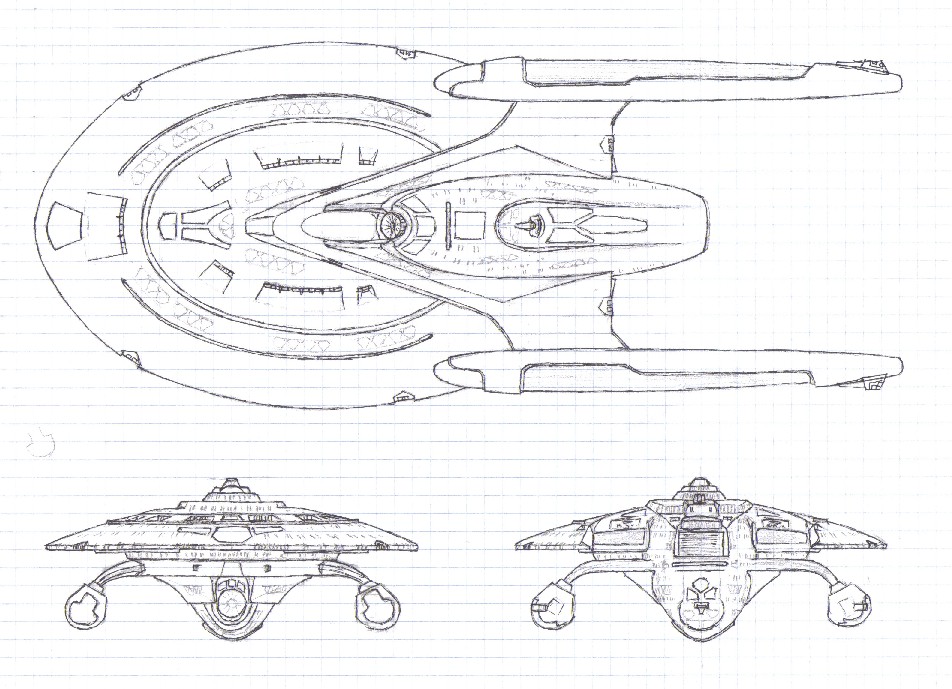
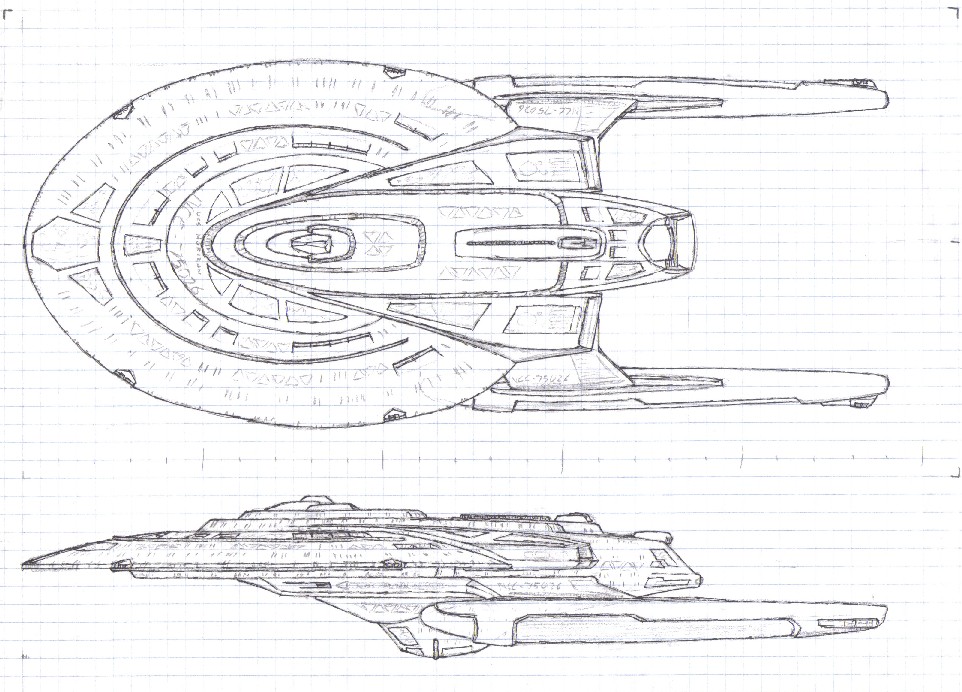 Design by David Bernard-Stevens
Type: Long-range explorer
First commissioned: 2381
Length: 481m
Width: 204m
Height: 90m
Decks: 16
Displacement: 1890000t
Complement: 112 officers + 250 crew, evacuation limit: 1850
Speed: Warp 9.4 (cruise), Warp 9.9 (max.), Warp 9.99 (max. emergency)
Sublight speed: 0.75c (max.)
Armament: 3 Type X phaser arrays, 4 Type VIII phaser arrays, photon/quantum torpedo
launchers (depending on loadout)
Defense: Standard shields and armour
Embarked craft: 4 Type 11 shuttles, equipment to construct custom shuttlecraft as needed.
The Horizon class is intended to supplement the existing Luna class exploration vessels in particularly long-range missions. Intended to develop the best aspects of the Luna class while incorporating several suggested improvements, the Horizon focuses more on speed, sensor capability, and defensive systems rather than tactical systems to avoid dangerous situations. The Horizon class also has increased capacity for longer duration survey missions well beyond explored Federation space, which effectively complements the Luna's "trailblazing" missions.
Hubble Class

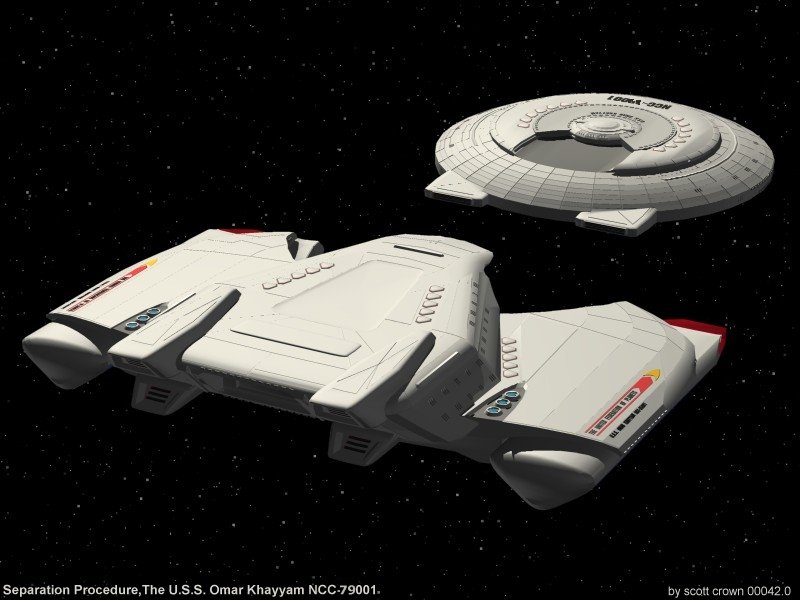
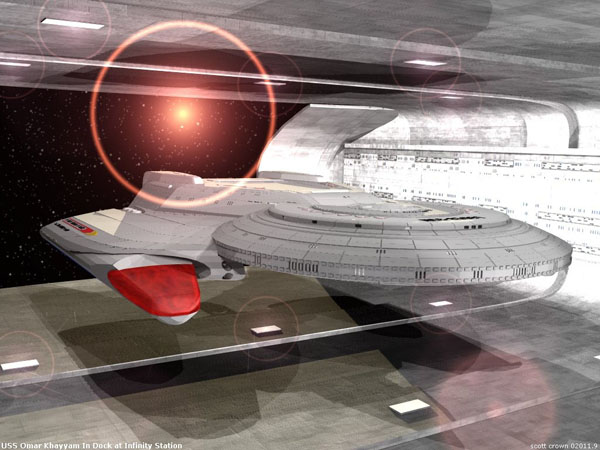
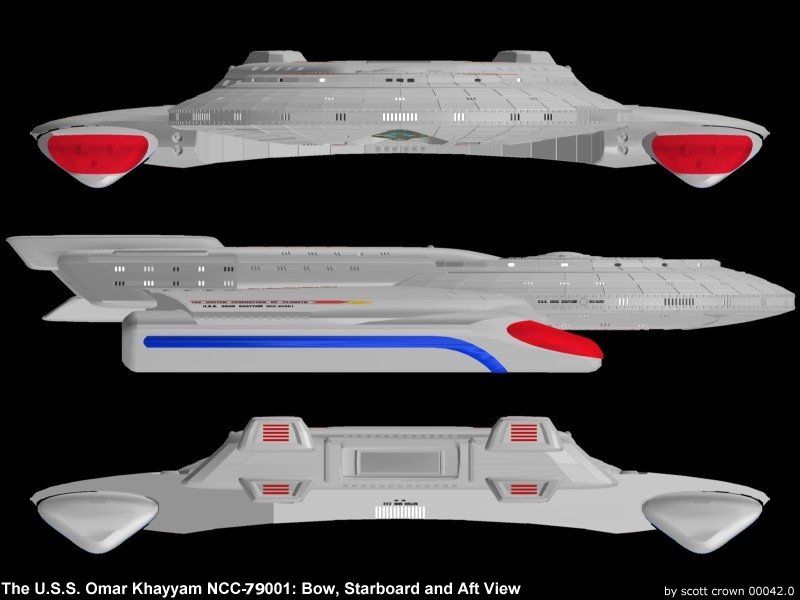 Design
by Robert Jackson
Design
by Robert Jackson
Type: Research vessel
Length: 252.229m
Beam: 236.271m
Draft: 44.003m
Decks: 8
Mass: 556,000mt
Speed, Warp 9.000 (std. cruise), Warp 9.975 (max. cruise), Warp 9.9980 comparative
(max. attainable, tethered)
Crew complement: 225
 With the large losses suffered during the Borg incursions and the Dominion War,
combined with the number of spaceframes over 100 years old, Starfleet found it
needed a long-term, mid-range research vessel to fill the gap between the
long-range exploration classes and the short-range scout/surveyors. The ideal
vessel would be both a multi-mission vessel and a mission-specific vessel to
fulfill the requirement for detailed research into the broadening areas of
Federation space. With the large frame vessels assigned as the new deterrent
explorers, Starfleet intended to use these ships in the explored, but largely
unresearched areas, of Federation controlled space. The typical mission would be
staged out of Starbases and last for a few months up to a year at most. The
primary role of the vessel would be scientific research, with the ability to
remain on-station for undetermined duration and take care of itself far from
normal support
With the large losses suffered during the Borg incursions and the Dominion War,
combined with the number of spaceframes over 100 years old, Starfleet found it
needed a long-term, mid-range research vessel to fill the gap between the
long-range exploration classes and the short-range scout/surveyors. The ideal
vessel would be both a multi-mission vessel and a mission-specific vessel to
fulfill the requirement for detailed research into the broadening areas of
Federation space. With the large frame vessels assigned as the new deterrent
explorers, Starfleet intended to use these ships in the explored, but largely
unresearched areas, of Federation controlled space. The typical mission would be
staged out of Starbases and last for a few months up to a year at most. The
primary role of the vessel would be scientific research, with the ability to
remain on-station for undetermined duration and take care of itself far from
normal support
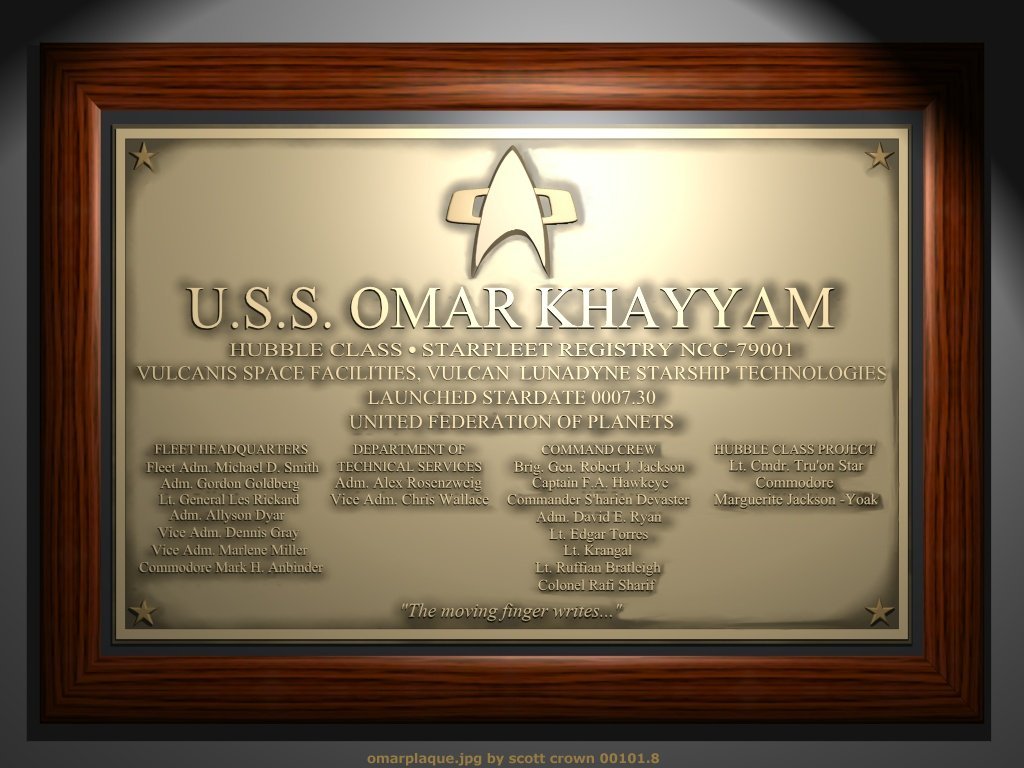
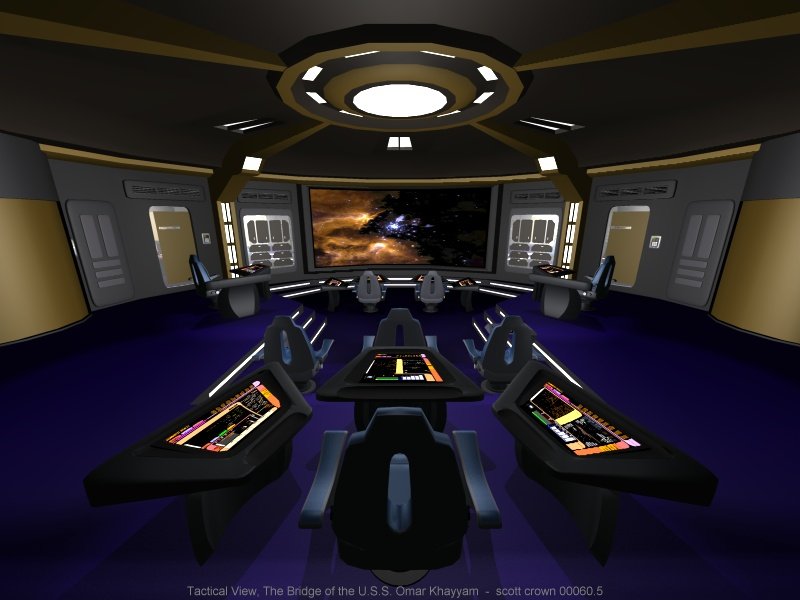
The Hubble class was conceived and designed by Captain Tru'on Star of Andor as a dual role multi-mission/mission specific research vessel. The Hubble class design fulfills the stated mission requirement for mission duration and independent operation.
With the addition of an advanced (limited use) trans-warp propulsion system, the Omar Khayyam (Hubble class) is recognizably more energy efficient than other vessels of its type in the high warp bands. Comparisons to the Galaxy class energy system indicates the standard warp drive at propulsive warp 3 emits a level of energy nearly equal to what the Trans-warp system uses to go to warp 8 equivalent. Coupled with the trans-finite propulsion system gives the vessel an ultra-warp capability that can carry the vessel marginally into the high warp bands assuming that power conservation is maintained. This is a rare event, however, since the dangers of traveling at this relative velocity are numerous. However, since the primary function of the Trans-finite propulsion system isn't higher speed, it can be assumed that when enough power is applied, the effect will result in a temporal transition or "ripping of the quantum fabric". Since the theory and applications are much different than standard Federation warp technology, and involve much different forms of energy/spatial contact, the standard engine systems will be tethered to the high warp 9 factor for safety reasons.
Hyppolyta Class
 Design by James Donovan
First launched: 2374
Length: 385m
Beam: 170m
Decks: 19
Mass: 840,000t
Crew complement: 250
Speed: Warp 9.75 (max.)
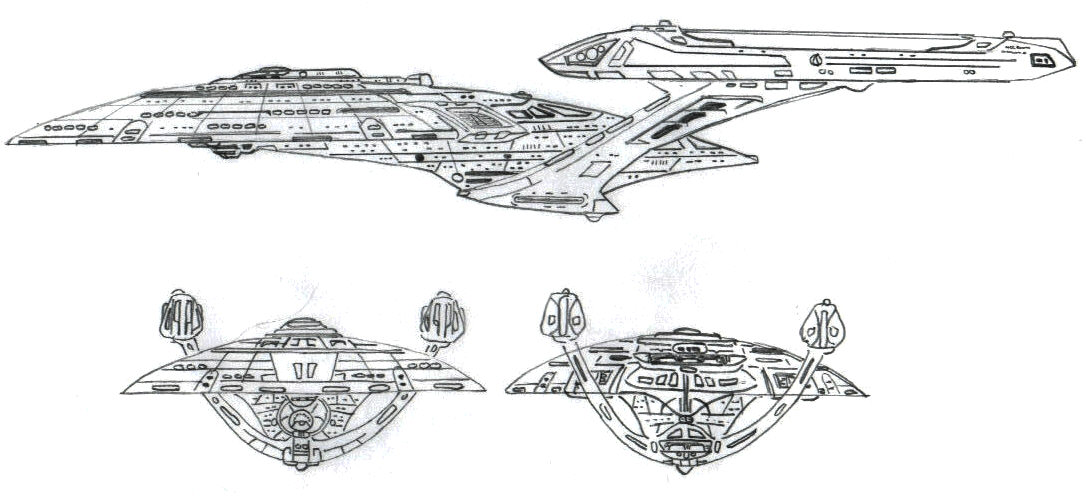

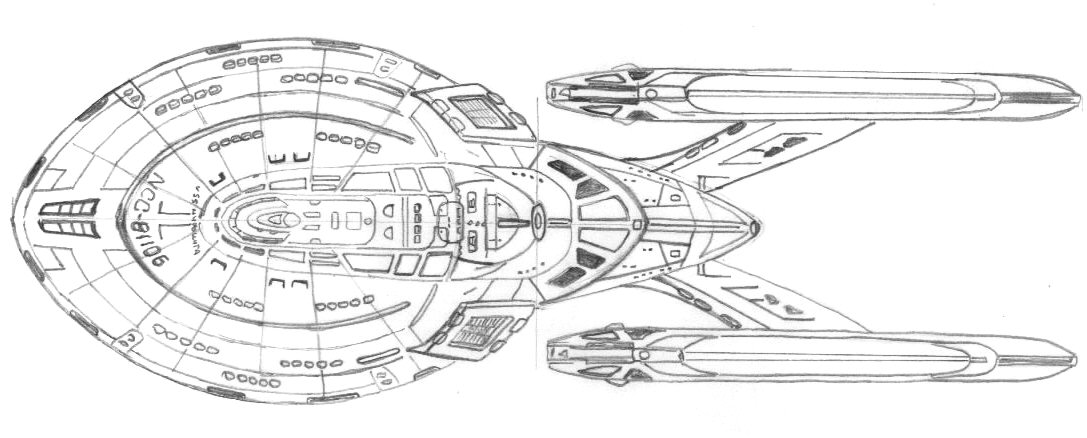 Ships
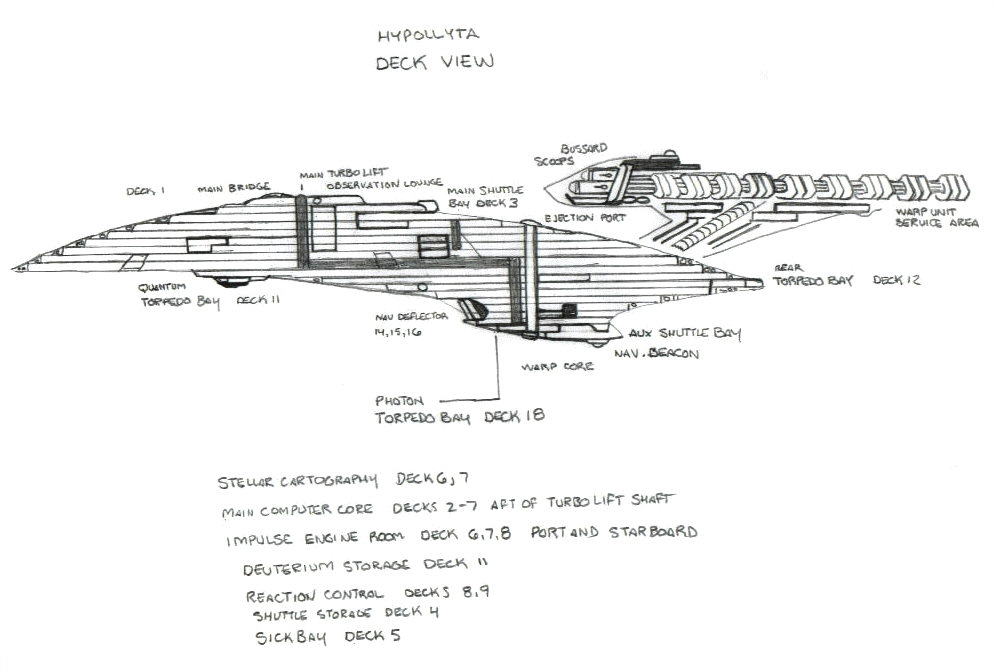
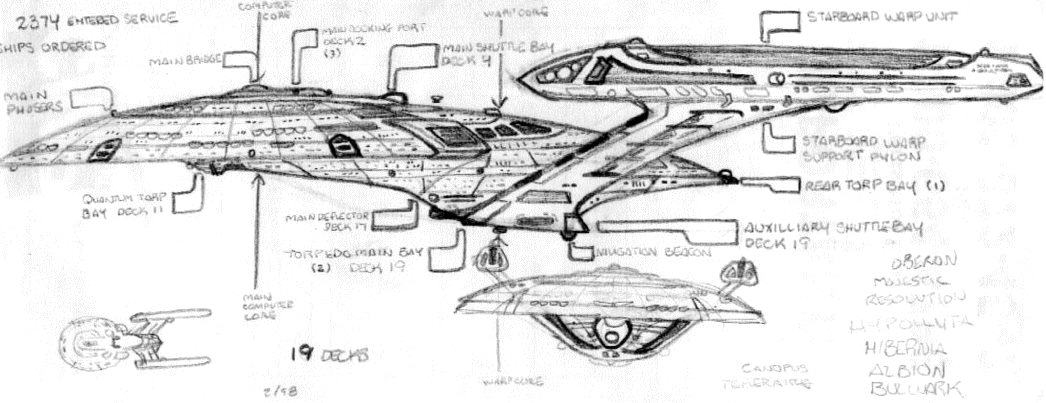
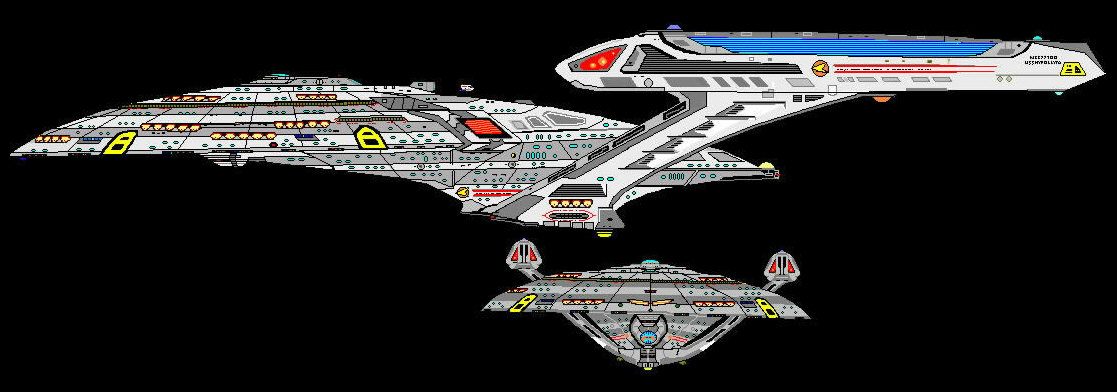
in this class are: Hyppolyta, Gesthemene, Thessaloniki, Sparta,
Pelloponesus, Simla, Srinagar, Ceylon, Iberia, Vladivostok, Victoria,
Amphitrite, Avalon, Canopus, Temeraire, Bulwark, Albion, Hibernia,
Resolution, Majestic, and Oberon. The lead ship was launched in 2374 has a
top speed of warp 9.75. The secondary (auxiliary) shuttle bay is located
on deck 19 at the lower fantail. The ship was based on the larger
sovereign class with some visual differences apparent. It is half the
size, and slightly larger than the Intrepid class. It does not have
planetary landing capability. There is the now familiar quantum torpedo
pod below the saucer, with two standard torpedo launchers on the bottom of
the secondary hull. There are two rear firing torpedoes at the extreme end
of the rear secondary hull.
Ships
in this class are: Hyppolyta, Gesthemene, Thessaloniki, Sparta,
Pelloponesus, Simla, Srinagar, Ceylon, Iberia, Vladivostok, Victoria,
Amphitrite, Avalon, Canopus, Temeraire, Bulwark, Albion, Hibernia,
Resolution, Majestic, and Oberon. The lead ship was launched in 2374 has a
top speed of warp 9.75. The secondary (auxiliary) shuttle bay is located
on deck 19 at the lower fantail. The ship was based on the larger
sovereign class with some visual differences apparent. It is half the
size, and slightly larger than the Intrepid class. It does not have
planetary landing capability. There is the now familiar quantum torpedo
pod below the saucer, with two standard torpedo launchers on the bottom of
the secondary hull. There are two rear firing torpedoes at the extreme end
of the rear secondary hull.
| Home | ||
|
||
| Last modified: 06.03.18 |  |
|