
![]() |
Advanced
Starship Design Bureau Space Stations |
||
| Starships | Shuttles | Equipment | Technology | History | Other | New | Submit | |||

Starships
Starships A-B, C-E, F-H,
I-L, M-N, O-Q,
R-S, T-Z, Space Stations
NCX Type
![]()
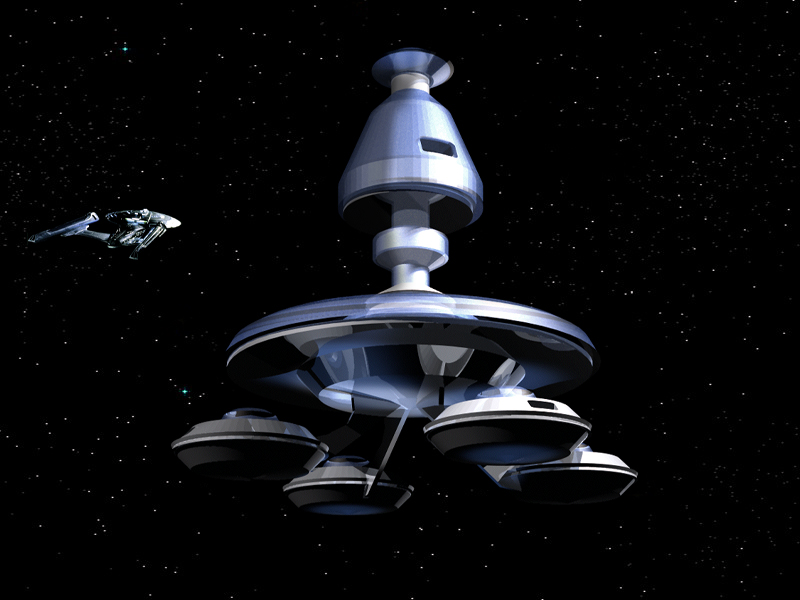
Design by David Lovejoy
Diameter: 2.75km
Height: 4.5km
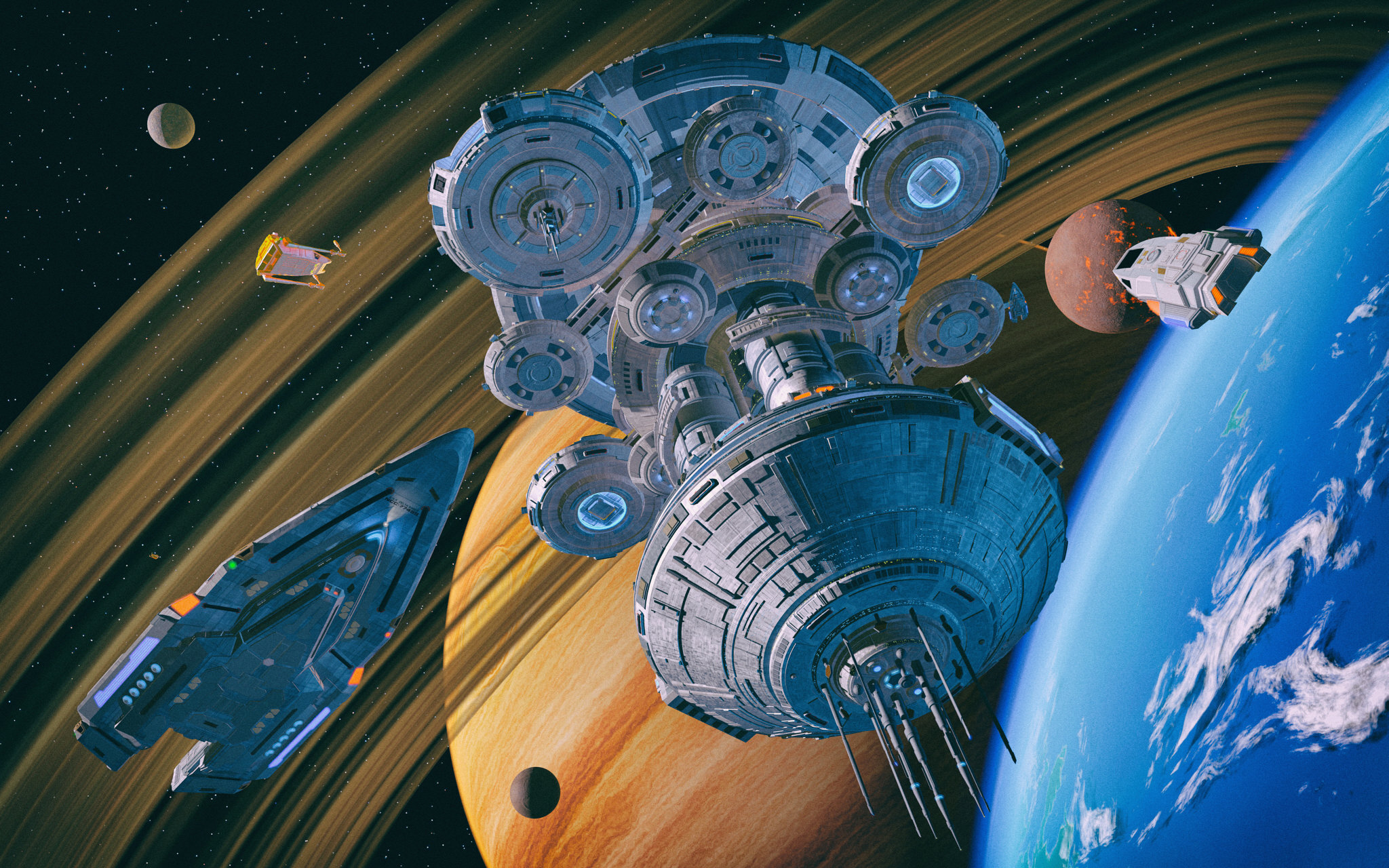
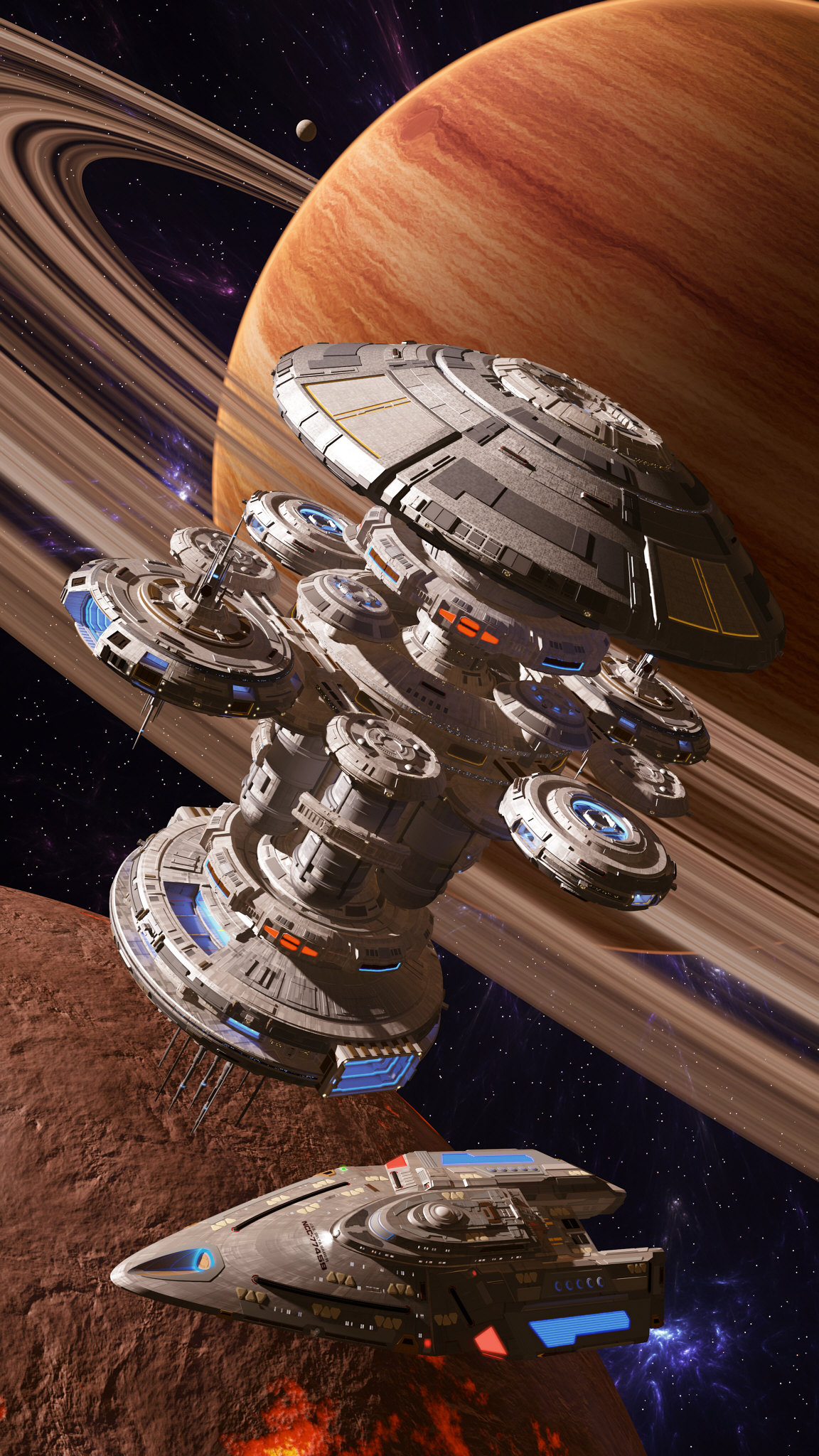
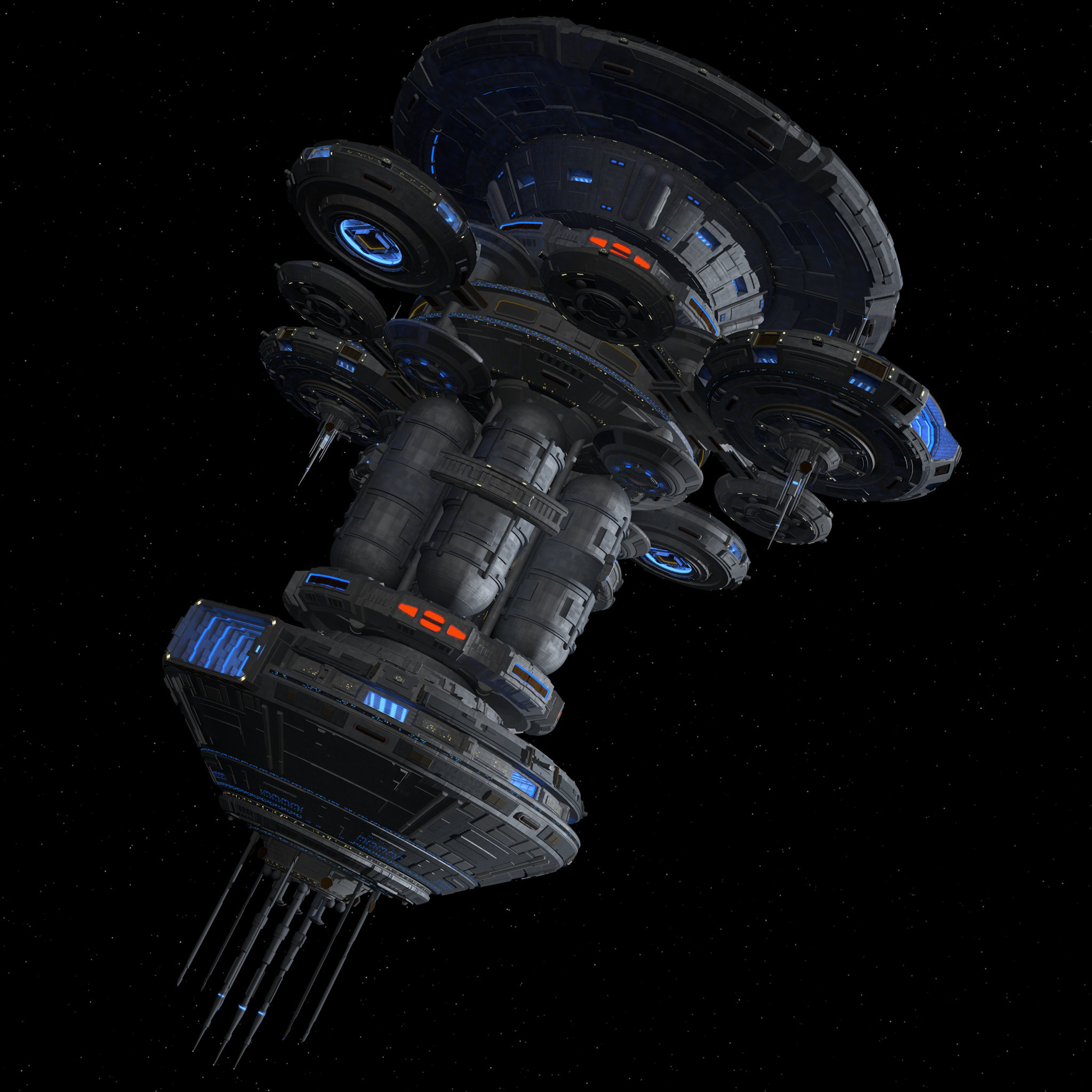
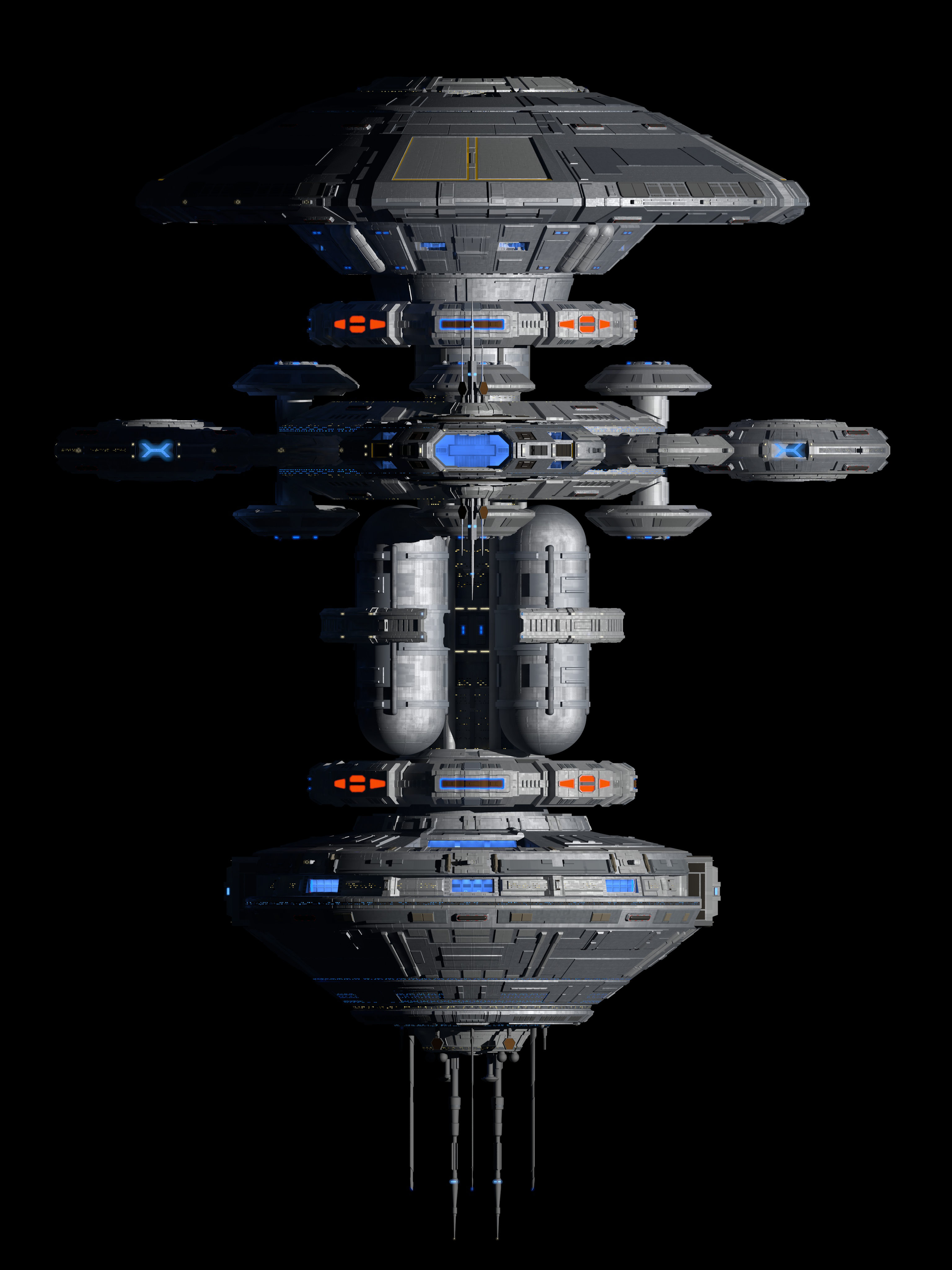
The NCX is a class of slightly smaller and more practical deep space stations built in the mid-2380s to serve as home bases for exploratory vessels on the Federation frontier. The station features four saucer-shaped docking modules capable of accommodating five small vessels each. An upper main docking facility allows capital ships to repair, refeul, or refit. Atop the main docking module is a command module, and in the center is the massive concourse module which is comprised of the power core, storage facilities for deuterium, dilithium, ordinance, parts, and other provisions, supplemented by a massive replication facility and a network of quarters for crew members and guests. These well-equipped bases, as well as new communication technology pioneered by the MIDAS array, extend the range of Starfleet, allowing for exploration of sectors thousands of light-years from Earth.
Prince Edward Island Class ![]()


Design by Robert Heckadon
Type: Lighthouse
First commissioned: 1124.1
Length: 279m
Width: 52m
Height: 169m
Decks: 10
Complement: 10 officers + 40 crew
Sublight speed: 0.001c (max.)
Armament: none
Defense: Magnetic radiation shields
Embarked craft: 1 docking shuttle
“All that we see or seem, Is but a dream within a dream?” - Edgar Allen Poe
Inspirations for mysteries and ghost stories, lighthouses have been guiding sailing ships to safe harbours for many years. Over time, lighthouses have been replaced with radio beacons and then with the global positioning system (GPS). But lighthouses have been making a comeback in the mid 23rd century to bring transport ships and civilian vessels to save harbour, all beginning with the Prince Edward Island class.
The Prince Edward Island class space station is both a space traffic control centre and a subspace navigation beacon transmitter station. With the use of 4 large subspace radio transmitters at the bottom of the station, it emits a homing signal for warp capable starships to follow back to the station’s home star system. This is useful since unlike Starfleet exploration vessels, such as the Constitution class, most civilian and transport ships rely upon tachyon sonar, visual sensors, and subspace radio for navigation.
The station's transmitters are powered by 4 nuclear reactors located in a circular structure above the transmitters, with the deuterium fuel supply located in the stations vertical shafts. Though quite capable of tapping fusion energy from the reactors, the stations primary systems, such as life support and gravity, are primarily powered by solar energy which is collected by 2 pairs of photoelectric panels on either side of the stations habitat section.
Atop of the station is a rotating mirror. Mostly for nostalgic reasons, and for the reason the station is called a lighthouse, the mirror reflects sunlight to give it visually appealing pulses of light. The mirror’s rotation is maintained by a device once referred to as a flywheel and kept spinning by inertia.
Lacking a shuttle bay, the space station has 4 docking ports with one docking port manned at all times by an impulse docking shuttle. Another docking port is actually an umbilical connection used by supply ships to replenish the station’s resources. This includes atmosphere, water, and fuel.
The range of the station’s navigation signal depends on the ships receiving the signal. According to Starfleet regulations, the lighthouse’s navigational signal must be strong enough for civilian and transport ships to detect it 30 lightyears away. With the same intensity, military ships can detect the signal 50 lightyears away. Heavy cruisers and explorers at 120 lightyears. And dedicated science vessels at almost 200 lightyears.
Critics of the lighthouse have said that a nuclear powered subspace navigational beacon or a solar powered radio beacon would be just as effective over a manned space station. Though many star systems do use solar and nuclear powered beacons, the lighthouse is a space traffic control centre that both guides and coordinates space traffic throughout the Federation.
After over a hundred years, though new stations have been built, even in the 24th century these stations are indispensable for people traveling within the Federation.
Somalia Class ![]()


Design by Robert Heckadon
Type: Famine relief station
First commissioned: 2251
Length: 451m
Width: 391m
Height: 206m
Decks: 65
Complement: 50 officers + 450 crew
Armament: 12 phasers, 2 photon torpedo launchers
Defense: Level 7 deflector shields.
Embarked craft: 7-person shuttles and cargo shuttles
“We don’t need another hero.” - Tina Turner
Even in the 23rd century, where poverty, disease and war on Earth became all but extinct for over 150 years, ravaged by global wars or massive natural disasters, famine still exists on other planets in the galaxy. In order to feed 100 million people, it would require over 50,000 metric tonnes of food per day, depending on species. Rather than sending in large scale shipments of food to the starving planets, it was deemed better for both security and economic reasons to have a space station orbit the planet to feed the starving millions below. In 2251, the first of 10 famine relief stations were built.
As with many deep space outposts, the retro looking space stations were based upon the Space Island Projects prior to the Eugenics wars. The famine relief stations were constructed well within Federation space and transported by tug ships to bring them to the planet and assembled. And later disassembled when the mission is over. The station is composed of 3 modules. The vertical module is the stations command module. It is here where the command centre, living quarters, personal transporters, primary life support, and primary solar collectors are located. The 2 horizontal modules are the manufacturing facilities were food is made and water is recycled.
Even if significant bodies of water are available, during a famine, the water is usually undrinkable cause of bacteria, biohazardous material, and other pollutants. After being beamed up, fresh water is extracted by electrolysis. Breaking water down into hydrogen and oxygen. The hydrogen and oxygen are then reformed into distilled water in fuel cells that also provides additional energy to the electrolysis systems. Thereby saving energy for transporters and food processors. The remaining material is then sterilized by intense X-rays, and separated into organic and non-organic groups. The organic now sterilized are then sent to the food processing areas of the module while the non-organic are then recycled on spot.
The stations manufactures food by first of all, searching and gathering dead or expendable bio-matter, such as grass clippings, twigs and dead leaves, from the surface of the planet. Then this bio-matter is beamed up to the station where they are non-chemically converted into foodstuff using protein resequencers, and beamed back down to the surface to feed the millions. Protein resequencers can manufacture many forms of fruits, vegetables, meat, nuts and so forth depending on the diet of the species. But due to lack of time and power, everyone receives the same food at each delivery, and often adds some variety to the meals.
Due to strict environmental regulations, the planet below must have a stable ecosystem and expendable bio-matter, since the station is not capable of generating bio-matter, just converting it into foodstuff. Since methods such as mass deforestation is not an option. That would cause more harm in the long run. Starships and space stations uses hydroponics and chemosynthesis to generate food stuff and oxygen. But in order to generate that much for millions, nearly a dozen space stations are required, along with an enormous solar array to power the transporters to beam up the tonnes of water and carbon dioxide from the atmosphere. This is one of the reasons why the space station wasn’t used on Earth colony Cygnia Minor when it was threatened with famine in 2266.
One of the reasons why a space station is a better choice is because of security. Large scale shipments of food can be intercepted by aliens, rogue governments, or pirate that may benefit from the starving populations. Even on a humanitarian mission, the station is heavily armed and shielded, almost equivalent to a Constitution class starship, to protect itself. And the station also is more economically viable for savings on fuel and transportation costs.
The station has been labelled as being very cramped and uncomfortable. Often averaging one toilet for every 5 crew members and 1 shower for every 10. But often that is one more shower and toilet more than what the famine victims have. Finding crews for the stations surprisingly has not been a problem with many of them being from organizations outside of Starfleet. This include the Kir’Shara group of Vulcan, the Vaz’Xolraz of Denobula, and UNICEF of Earth.
Critics have questioned as to why keep the space station in orbit instead of putting the facilities on the ground. One reason is also a security issue, terrorism. Though a high 90%, often reaching 99%, are grateful for having a meal and drinking water, there is a small percentage that views the Federation with suspicion. And a few extremists willing to allow their people to die of starvation instead of having them “roll over and play dead” for the Federation.
Another reason is access to bio-matter. If one side of a planet whose economy and ecology has collapsed, while the other side of the planet has more then enough bio-matter to sustain them, it makes more sense for a space station to orbit a planet every 2 hours, depending on the size and conditions of the planet, to beam up the material while the station is overhead and beam down the food that has been process while over the population, rather than using up resources and time to shuttle bio-matter from one side of the planet to the other.
The station can synthesise many common pharmaceuticals ranging from Hyronalin, an anti-radiation medicine, to Retnax 5, a common eye-lens softener for the treatment of Presbyopia. Which can be grown in the station’s limited hydroponics bays.
Over their 150 year life span, the space stations were upgraded on a routine basis. Replacing the old protein resequencers with replicators, and adding on a holodeck for the exhausted crew members.
Prior to the Dominion war, the famine relief stations have only seen action once. A rogue Klingon D7 battle cruiser attacked the station and was destroyed by a standard patrol ship that are constantly seen with the stations. However, during the Dominion wars, 5 of these 10 stations were attacked and destroyed. Now the wars are over, Starfleet is not only replacing the 5 destroyed stations, but are also building 10 more to combat the aftermath of the war.
http://www.beyondtomorrow.com.au/stories/ep31/babyboomer.html
http://www.spaceislandgroup.com/home.html
http://www.unicef.org/
http://www.pmel.noaa.gov/vents/nemo/explorer/concepts/chemosynthesis.html
Space Island Class ![]()
![]()


Design by Robert Heckadon
Type: Peace keeping starbase
First commissioned: 2241
Length: 459m
Width: 658m
Height: 330m
Decks: 83
Displacement: 2100000t
Complement: 125 officers + 1125 crew, evacuation limit: 6000
Speed: Warp (cruise), Warp (max.), Warp (max. emergency)
Sublight speed: 0.001c (max.)
Armament: 12 phasers, 2 banks each; 4 photon torpedo launchers, 250 photon torpedoes.
Defense: Cast rodinium shields, magnetic radiation shields
Embarked craft: 10 standard shuttles, 4 cargo shuttles
“For he is a man who can stop the world from blowing up, but it is up to the people to keep the world from blowing up.” - Why The World Needs Superman by Lois Lane
In the early to mid 21st century, the Space Island Project used the external fuel tanks of space shuttles to construct relatively large scale space stations in Earth’s orbit. In the mid 23rd century, this concept of a new class of fully manned space stations that are needed to stabilize a region of space, but the region of space is deemed too unstable to risk a fully manned space station. Thus enter the Space Island class starbase.
First introduced in 2241, the Space Island class is a modular space station designed to stabilize a region of space by giving different worlds a place to work out their differences peacefully. Aside for being a home for 1250 officers and crew, and over 1000 diplomats, businesspersons, and explorers, it is designed to be transported in separate modules by standard tug/transport ships and assembled within a matter of days. And in the event that the situation goes so critical that it is totally unsafe for a Starfleet presence, the space station can be disassembled and returned to Federation space in a matter of days.
The Space Island class is divided up into 12 modules, which are constructed safely in Federation space and transported to their destination outside of Federation space by standard tug/transport ships, including the Ptolemy class, Sachsahuaman class and Fisher class transport ships. Once there, they only require as little as 6 days to set up the starbase. Assembling the modules into the space station takes only 24 to 48 hours, often averaging 37.7 hours. And the remainder of the 6 days is spent bringing the station’s 2 matter/antimatter reactors online, full diagnostics of all key systems, crew orientation, current situation analysis, and the installation of the station's solar collectors.
In the event that the political situation deteriorates beyond recovery, the station can be disassembled and returned to Federation space in only a matter of days, while only sacrificing the station's solar collectors. To this date, this has yet to happen. Though there have been incidences of these space stations being in combat.
The stations modules are based upon the 200 metre long, 40 metre diameter transport containers for both the ease of construction and transportation of the disassembled space station. The station has 12 modules, 1 command module, 1 engineering module, 2 service modules, and 8 habitat modules.
The command module is essentially the heart of the whole station. Along with the main command centre located at the top, the command module houses offices and administrative support, tactical stations and situation analysis, as well as meeting rooms for commercial and political negotiations. And as expected, more than half of the profanity usage on the station occurs here. The engineering module houses the matter/antimatter reactors and the fuel, as well as the power and system control rooms. Before the journey, the engineering module is attached to the command module on the bottom for easier transit and reduced assembly time. The stations solar collectors are attached to the bottom of the station, and they require special transport. The 2 service modules, which extends on either side of the command module, contains the station’s shuttle bays, cargo holds, fabrication centres, recycling and the primary artillery. The station’s total firepower is listed as being over 3 times that of a Constitution class starship. The 8 habitat modules, 4 on each of the service modules, provides living quarters and suites for the guests, crew, and general population. They also contain entertainment and recreation for the entire population of the station. Starship docking ports are located on the habitat modules.
After a region of space has been stabilized, the Space Island class then coordinates the set up of refuelling stations and other space stations in the region, then coordinates the construction of larger starbases, including the Watchtower class, in other star systems in the region of space.
The Space Island class has also inspired other modular, transportable space stations including the Somalia class famine relief station, the Arthur C. Clarke science station, and Deep Space 1. Critics have stated that the Watchtower class starbase, like Starbase 47, Vanguard Station, is more suited for the task of stabilizing a region of space. However the political situation can change drastically within a matter of weeks, and it takes about 4 years to properly build a Watchtower class starbase, and 2 years if it were rushed.
The number of new Space Island class space stations dropped drastically when Excelsior class starships became as much of a frequent site as the Constitution and Enterprise class use to be. And the numbers finally ceased with the introduction of the Ambassador class starship.
Notes Since the solar collectors can pivot a full 360 degrees on the X and Y axis, the dimension of the space station are with the solar collectors perpendicular to the service modules, and parallel to the command module for maximum XYZ dimensions of the space station.
Designer's
note This space station is free for anyone for non-commercial use, including fan sites, fan fictions and so forth. Commercial use requires permission.
Spacedock One
![]()


Design by
Kris,
ASDB Member
2192-2273
Diameter: 1888m
Height: 2406m
Mass: 43,025,872mt
No description
Starbase Type 1 - Freestyle Class
![]()
Design by G.I.B.
Diameter: 4.8km
Height: 5.4km
No description
Starbase Type 2 - Trifertika Class
![]()
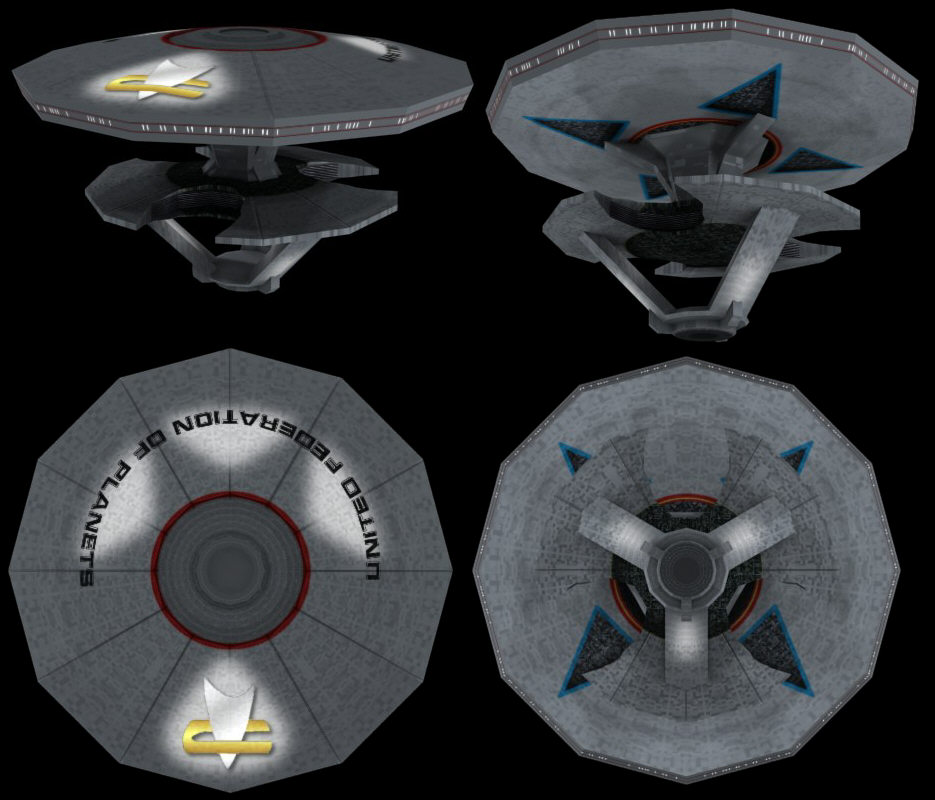
Design by G.I.B.
Diameter: 7.6km
Height: 4.4km
No description
Starbase Type 3
![]()
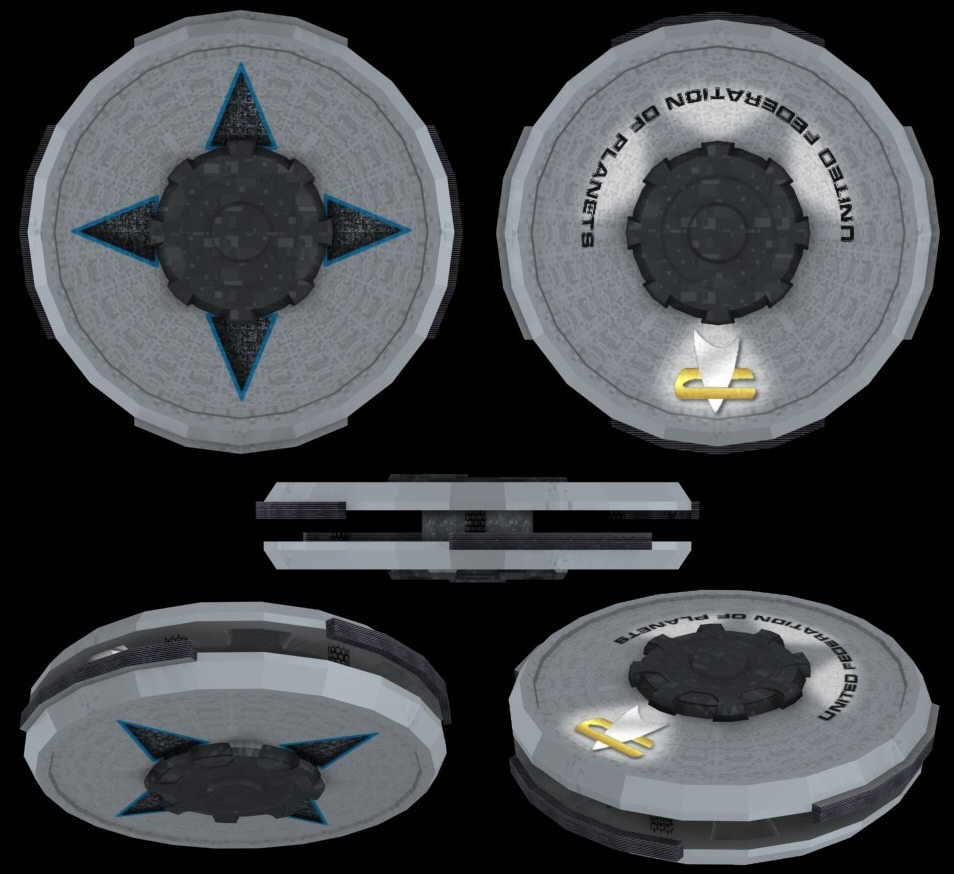
Design by G.I.B.
Diameter: 10.4km
Height: 2.6km
In battle mode, the starbase can "close" (the upper and lower part connect together), to protect everything (including the docked ships) inside. This design was inspired by the Cylon base from "Battlestar Galactica".
Starbase Type 4
![]()
Design by G.I.B.
No specs available
This starbase may hold 4 Intrepids in each bay, 8 in total. Or 2 to 4 Galaxies in total.
Starbase Type 5 - Altero Class Variant 1
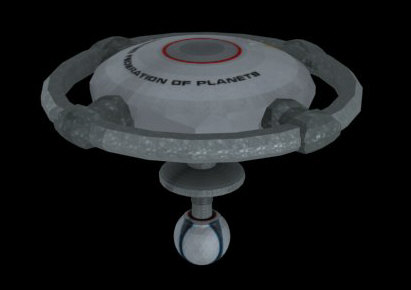
![]()
Design by G.I.B.
Diameter: 11.4km
Height: 8.4km
This base has 4 internal reapair/construction bays in the outer ring and 4 external docking bays in the lower mid section.
Starbase Type 6
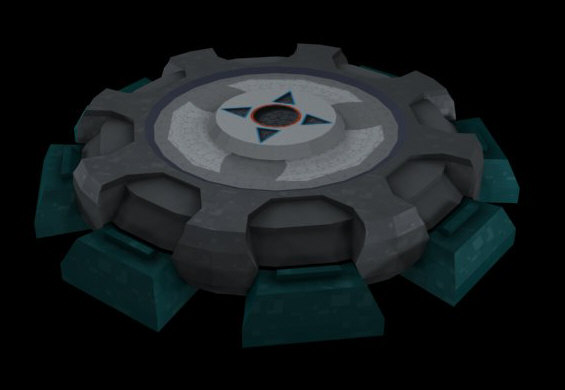
![]()
Design by G.I.B.
Diameter: 9.5km
Height: 1.65km
This starbase can be built into SB3 and has the option to land on the starbase dock station on a planet.
Starbase Type 8
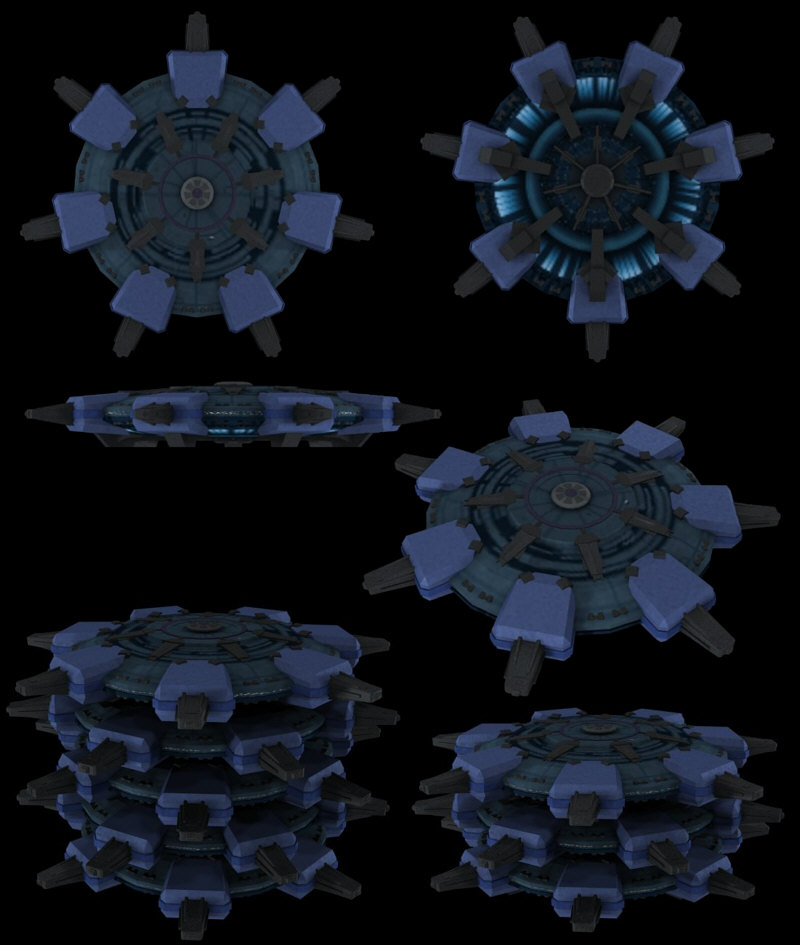
![]()
Design by G.I.B.
Diameter: 3.9km
Height: 0.6km (1.8km as a three-parter)
In case of emergency, the parts can disconnect from each other and become mobile and impulse capable.
| Home | ||
| Last modified: 15.05.08 | ||